

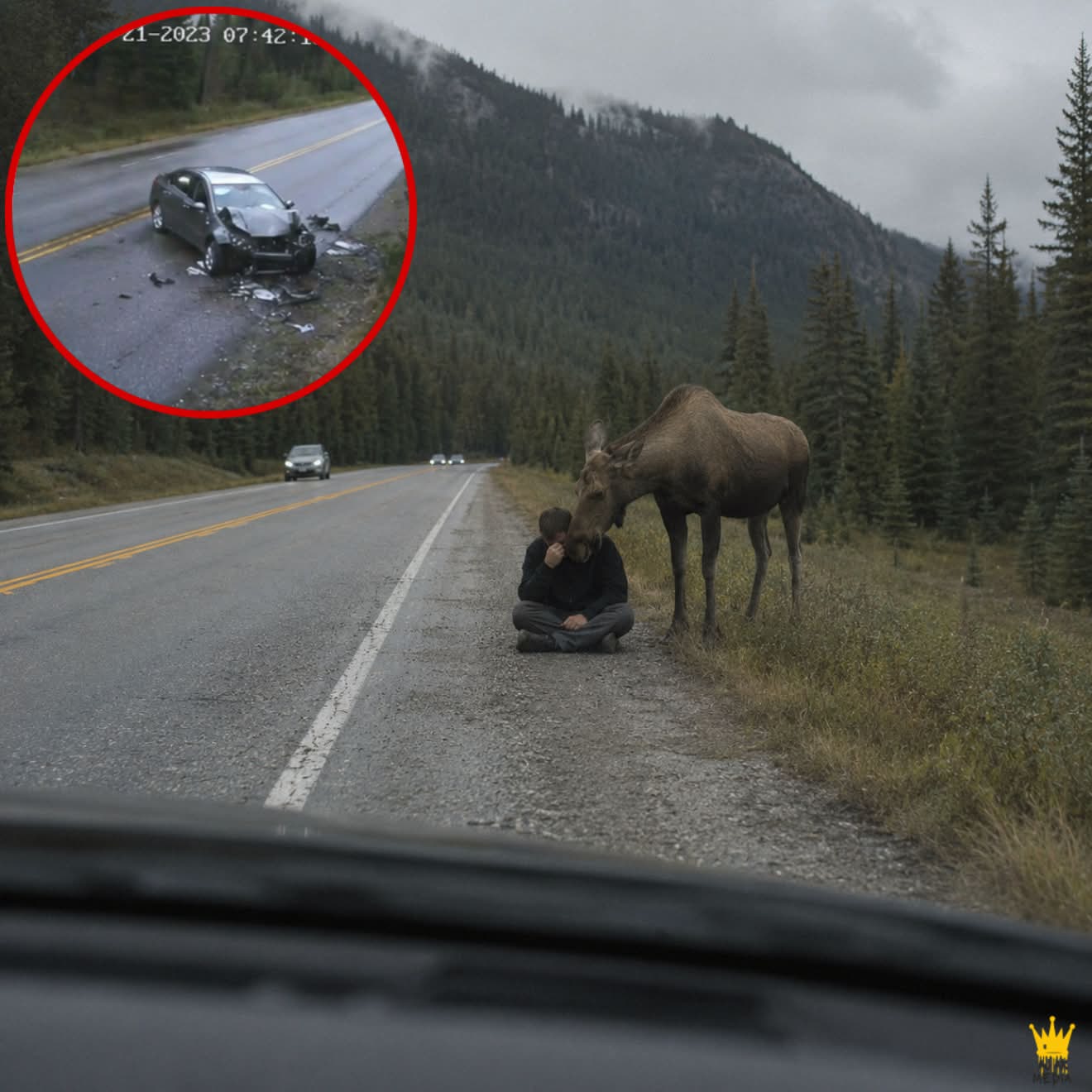
The first thing I saw was the shape of antlers moving between the birch trees.
At first, I thought grief had finally started showing me things. It was dusk, the kind of soft blue hour when the road lost its edges and every shadow looked like it was holding its breath. My husband, Mark, sat on the gravel shoulder with his back to me, one hand on the wooden cross he had placed there himself, the other resting open in his lap.
Then the antlers moved again.
I stopped breathing for a second.
“Mark,” I whispered, though the car windows were up and he couldn’t have heard me.
He didn’t turn.
The moose stepped out slowly, as if it had been standing there all along and only now decided we were ready to see it. It was massive, darker than the trees behind it, with long legs that seemed too delicate for such a heavy body. Its ears flicked once. Its nose lifted toward the air.
I reached for the door handle, then froze.
If I startled it, if I shouted, if I did anything wrong, I didn’t know what would happen. Moose were not storybook animals. They did not wander out of the woods to pose for pretty pictures. They could be unpredictable, especially when cornered or frightened.
But this one did not look frightened.
It looked at Mark.
My husband had come here every year since the night our daughter never made it home. Same stretch of road. Same bend where the pavement dipped and the trees crowded too close. Same little white cross, fresh flowers tied with twine, a ribbon that had faded from yellow to almost cream.
He never spoke much on these evenings. He would say, “I’m going to sit with her,” and I would nod because there was no sentence in the world big enough to answer that.
So I waited in the car, close enough to watch him, far enough to let him fall apart without feeling watched.
That was what marriage had become in some moments: knowing when to reach and when to remain still.
The first year, he had stood there until his knees gave out. The second year, he brought her favorite candy and left it tucked beneath the flowers. The third, he read a birthday card he had never mailed because she had bought it for him and hidden it in a kitchen drawer before everything changed.
This year, he had said nothing the whole drive.
His face had been turned toward the window, the lines around his mouth deeper than they used to be. Rain had fallen earlier, and the roadside smelled like wet leaves and old dust. When we pulled over, he got out with the slow care of a man twice his age.
“Take your time,” I told him.
He nodded once.
Now the moose was coming closer.
One step. Then another.
Its hooves pressed softly into the damp shoulder. Gravel shifted under its weight. Mark looked up then, and I saw his shoulders stiffen.
For a moment neither of them moved.
I wanted to call his name. I wanted to tell him to stand, to back away, to come to the car. Instead, my hand found my phone. Not because I wanted proof. Not at first. I think some part of me understood that if something tender was about to happen in a world that had been cruel to him, I should not interrupt it.
The moose lowered its head slightly.
Mark’s hand lifted from his lap, not reaching, just hovering.
“Hey,” he said.
His voice was so low I could barely hear it through the glass.
The moose took one more step and stopped beside him.
It was close enough that its breath stirred the hair near his temple. Close enough that I could see the damp shine of its nose, the pale ridges in its antlers, the way its lashes caught the last light. Mark did not touch it. He sat utterly still, as if he understood he had been trusted with something and one wrong movement might break it.
Then the moose bowed its great head.
It rested its muzzle, gently, against his shoulder.
My husband’s face changed.
I had seen Mark cry many times since our daughter died, but this was different. Grief usually took him by force. It bent him forward. It emptied him. This time, his tears came quietly, almost in disbelief. His mouth opened like he was about to speak, but nothing came out.
The moose leaned there, warm and solid against him.
And Mark, after a long minute, closed his eyes.
Our daughter had loved animals with a fierceness that embarrassed her when she got older, though not enough to stop her from feeding stray cats behind the grocery store or crying over injured birds. As a little girl, she once spent an entire afternoon trying to convince us that a beetle on the porch was lonely.
“It needs a leaf,” she had insisted.
“For what?” Mark asked.
“For furniture.”
He had found her the biggest maple leaf in the yard, then sat cross-legged while she arranged twigs around the beetle like a tiny house.
After she was gone, Mark stopped telling those stories. Not because he had forgotten them. Because remembering her alive hurt worse than remembering the phone call.
That call had split our lives cleanly in two.
It came late, after the house had gone quiet, after I had turned off the kitchen light and Mark was pretending to read in bed. I remember the ringtone. I remember how he frowned at the number. I remember him saying, “This is Mark,” in the calm voice he used for strangers.
Then his face drained.
He sat down before his knees knew they needed to.
I only heard pieces. Road. Your daughter. We’re so sorry. Another vehicle. Left the scene.
There are sounds a person makes when the body receives what the mind refuses. My husband made one that night, and I still hear it sometimes in the space between sleep and waking.
For a long time afterward, people tried to comfort him.
They said she knew we loved her. They said she wouldn’t want him to suffer. They said time would help. They said everything people say when they are terrified of silence.
Mark thanked them because he was kind.
Then he went out to the garage and sat in her old camping chair until morning.
No one knew what to do with the part of him that had gone missing. Not his friends. Not his brother. Not me. I could sit beside him, make coffee, hold his hand under the table when someone said the wrong thing, but I could not follow him into the deepest part of that loss. That was where he kept being her father with nowhere to put it.
The moose stayed against him as the evening darkened.
A car passed slowly on the far side of the road, its tires hissing over wet pavement. The moose’s ear twitched, but it did not run. Mark opened his eyes and looked toward the trees, then back at the animal beside him.
“You knew, huh?” he whispered.
The moose breathed out, a soft, rough sound.
I pressed record.
My hands were shaking so badly the image blurred at the edges. In the video, Mark looked small beside that enormous animal. Not weak. Just human. A man sitting at the edge of a road with flowers at his feet and years of words trapped behind his ribs.
He lifted his hand slowly, giving the moose every chance to move away. It didn’t. His fingers rested for half a second against the thick fur near its jaw, then dropped again.
“I miss her,” he said.
There it was. Plain. Broken. Not the kind of thing people put in cards, not dressed up to make anyone comfortable.
The moose shifted its weight and pressed closer.
That was when Mark began to sob.
Not loudly. Not the way he had on the kitchen floor the night of the call. This was softer, worn down, like a door opening after being swollen shut for years. He covered his face with one hand. His shoulders trembled. The moose stood beside him, patient as weather.
I cried too, alone in the car, the phone still pointed through the windshield.
I kept thinking of our daughter at seven years old, standing barefoot in the yard with grass stains on her knees, telling her father not to scare a rabbit because “it’s probably got a whole day planned.”
She would have loved this animal. She would have laughed first, then gotten bossy.
“Dad, don’t move too fast. Dad, you’re making a weird face. Dad, this is a big deal.”
The thought hurt, but for once it did not only hurt.
After a while, the moose lifted its head.
Mark wiped his eyes with the heel of his hand. “Thank you,” he said, and his voice cracked around the words.
The moose looked at him for a moment longer. Its ears turned toward the woods. Then, with the same unhurried grace, it stepped away from the roadside and disappeared between the trees. Branches brushed its sides. The antlers were the last thing I saw, pale against the dim trunks, and then they were gone.
Mark sat still for several minutes.
I put my phone down.
When he finally stood, he did not look healed. I don’t believe grief works like that. He still moved carefully. His face was wet. He touched the cross once, straightened the ribbon, and bent to pick up a small stone that had rolled against the flowers.
But when he came back to the car, something in him had shifted.
He opened the door and sat beside me without speaking. The cool air came in with him, smelling of pine and rain. I reached for his hand.
This time, he reached back first.
We stayed there until the road grew dark and the first stars appeared above the trees. Before we left, Mark looked once more toward the woods.
“She would’ve said he needed a leaf,” he murmured.
I laughed through my tears because I could hear it exactly.
Mark leaned his head against the seat and closed his eyes. In his palm, he held the small roadside stone, warm now from his hand.
 StoryTime