

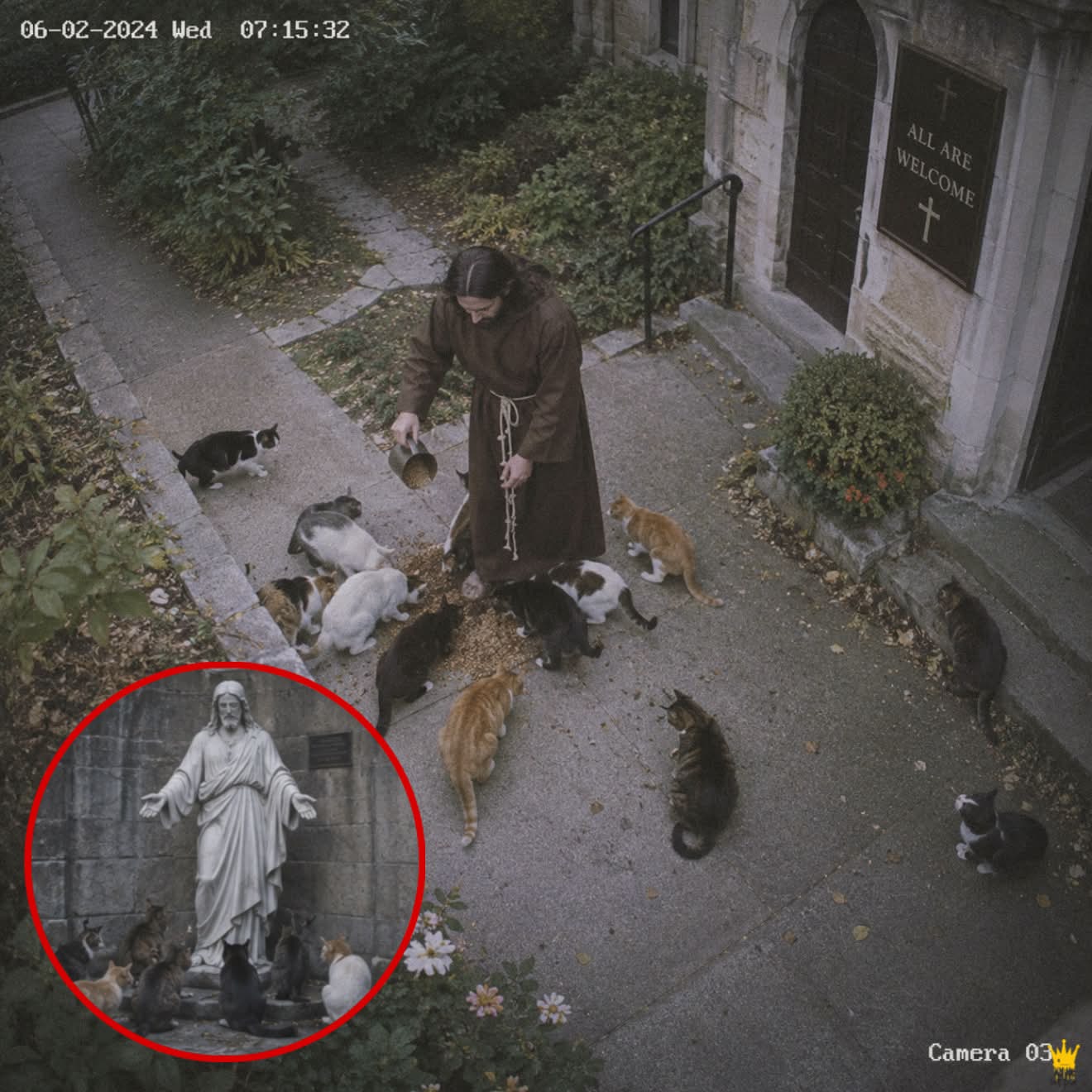
By the third morning, the cats were sitting in a half circle at the feet of the statue, their tails curled neatly around them as if someone had told them to wait.
Mara stopped on the walkway with her key still in her hand.
“Oh,” she said softly.
A gray tabby looked over its shoulder at her, blinked once, then turned back toward the statue. The others didn’t move at all. They faced the stone figure near the side wall of the church, the one with weather-softened robes and open hands, as quiet as children during a story.
There were usually cats around the church. Everyone knew that. A black-and-white tom slept under the hydrangeas most afternoons. Two ginger sisters haunted the kitchen steps, pretending not to care when someone brought out leftovers. A thin calico with torn ears had been coming and going for years, accepting food only if the bowl was placed down and the person walked away.
But this was different.
There were too many of them.
Mara counted under her breath. “One, two, three…”
She stopped at eleven because another small shape lifted its head from behind the statue’s base.
Inside, the old building smelled faintly of candle wax, lemon cleaner, and damp wood. Mara set her bag down in the entryway and found Jonah in the hall carrying a box of songbooks.
“You need to come look at something,” she told him.
He smiled. “If the freezer’s broken again, I’m pretending I didn’t hear you.”
“It’s cats.”
His smile faded into curiosity. “How many cats?”
“Enough.”
They went out together. The morning had that pale, early light that made everything seem washed and tender. The cats sat where Mara had left them. A few had dirty paws. One black kitten sneezed and tucked itself against a larger tortoiseshell. None of them begged. None wound around ankles or cried at the door.
They waited.
Jonah lowered the box onto the grass. “Well, that’s strange.”
“You fed them?”
“Not today.”
“Last night?”
He shook his head. “Mara, I fed the usual three by the trash shed. That’s it.”
One of the ginger sisters stood and stretched, then padded closer to the statue’s robe, pressing her cheek against the carved stone. The movement made Mara’s chest tighten in a way she didn’t understand.
By noon, half the neighborhood had heard.
People came carefully at first, stopping at the edge of the walkway with their phones raised low, whispering as if they had wandered into a hospital room. Mrs. Elena from across the street brought a foil pan of chicken scraps and nearly burst into tears when the cats didn’t run.
“They know this place is safe,” she said.
“Maybe,” Jonah answered, though he didn’t sound convinced.
The next morning, there were more.
A dusty orange male with a scar across his nose. A pair of black kittens with eyes too big for their faces. A long-haired white cat so matted it looked like it had rolled through leaves and slept in a chimney. They gathered before the first bell rang, appearing one by one from hedges, alleyways, and the narrow path behind the churchyard.
Mara watched from the kitchen window, her coffee cooling between both hands.
The cats did not behave like cats who had found a food source and were demanding it. They did not swarm. They did not yowl. They simply came to the statue and settled in front of it, their bodies arranged toward the same patch of empty ground.
Like someone was late.
By the end of the week, people were saying all kinds of things.
“It’s a sign,” Mrs. Elena insisted, setting down bowls of water.
“It’s a smell,” said Lyle, who fixed gutters and trusted no mystery that couldn’t be blamed on raccoons.
“It’s probably somebody feeding them,” Mara said, though she had begun to doubt herself. “Cats don’t gather for nothing.”
“Then where is the somebody?”
No one had an answer.
The church members tried to help without making the problem worse. They put food out in careful portions. They called a woman named Bea who trapped strays, took them to be fixed, and returned the ones too wild to keep. She came with crates in the back of her van and stood very still beside Mara, watching the cats.
“They’re not feral like I expected,” Bea murmured.
“No?”
“Some are. Most are just scared. Hungry, but scared.”
A small tabby crept toward Bea’s shoe, sniffed it, then sat on the toe as if claiming her. Bea looked down.
“Well,” she said, “that one has opinions.”
They laughed, but Mara could feel the unease beneath it.
By then, nearly fifteen cats had gathered at the statue, morning after morning. Some disappeared during the heat of the day and returned before dusk. Others slept in the shade beneath the low bushes, twitching in dreams. The kittens climbed the base of the statue and slid down again, while the older cats kept watch.
The white one, the matted one, always sat closest to the empty patch of ground.
Mara started calling him Snow, though he was more gray than white by then.
On the ninth morning, Jonah found her outside before sunrise.
“You’re early,” he said.
“So are they.”
The cats were already there. Their eyes reflected the amber light above the side door. Their ears all pointed in the same direction, toward the narrow lane that ran behind the building.
Mara followed their gaze.
Nothing moved.
Jonah rubbed the back of his neck. “We should check the cameras.”
She turned to him. “Why didn’t we do that sooner?”
“Because I kept hoping the answer would walk up and introduce itself.”
The security monitor was in a small office that always smelled like old paper and overbrewed coffee. Jonah pulled the chair close. Mara stood behind him, arms folded tight.
The first clips showed ordinary things. Wind moving branches. A moth throwing itself against the camera lens. The black-and-white tom crossing the lot with the offended dignity of a man wearing a too-small suit.
“Go earlier,” Mara said.
Jonah clicked back.
More empty hours. More shadows. A delivery left at the side door. Rain streaking across the lens.
Then Mara saw movement.
“Stop.”
Jonah froze the frame.
At the edge of the screen, just beyond the statue, stood a man in a brown robe.
Neither of them spoke.
The footage was grainy and tinted gray by the early light, but the man was clear enough. He moved slowly, his hood fallen back from his head, his sleeves loose around his wrists. He carried a cloth bag in one hand and a stack of shallow bowls in the other.
A cat appeared from under the bushes.
The man crouched.
He did not toss food and leave. He placed one bowl down, waited, and tipped his head slightly as the cat approached. Another cat came, then another. He spread the bowls apart so none of them had to fight. When a kitten tried to shove its face into the wrong dish, he gently moved the bowl closer instead of touching the kitten.
Mara leaned one hand against the desk.
“Oh,” she whispered.
Jonah clicked through the footage, going back morning by morning.
The man was there again. And again. Always early, before anyone arrived. Sometimes in mist. Sometimes in hard rain. Once, he sat on the lowest step beneath the statue while Snow ate from a bowl between his shoes. The cat’s matted head lifted, and the man’s hand hovered nearby, not forcing, only waiting.
Snow pushed his forehead into the man’s palm.
Mara felt tears rise so suddenly she had to look away.
For nearly a month, the man had come.
He fed the smallest first, the boldest last. He set out water. He broke pieces of food with his fingers for an old tabby who seemed to have trouble chewing. He spoke to them, though the camera held no sound. The cats knew him. That was the answer. Not a sign in the way people had meant it. Not magic. Habit. Trust. Hunger answered gently until it became hope.
“Who is he?” Mara asked.
Jonah shook his head. “I don’t know.”
They printed a still image from the footage and showed it around, carefully, without accusation. No one recognized him. Not the members who came every week. Not the neighbors. Not the woman who ran the small shop down the road. Bea studied the picture for a long time and frowned.
“Looks like he belongs somewhere,” she said. “But I’ve never seen him.”
“Maybe he was passing through.”
“For a month?”
Mara looked back at the still image. The man’s face was turned down toward the cats. Even blurred, there was something gentle in the bend of his shoulders.
News of the footage traveled faster than Mara wanted it to. People came asking to see the man in robes. Some used voices that made the whole thing feel less tender and more like a puzzle to be solved. They wanted a name, an explanation, a clean ending they could repeat over lunch.
But the cats wanted something simpler.
They came back the next morning and waited.
The bowls were there now, filled by Mara and Jonah and Mrs. Elena. Bea came twice a week, taking one cat at a time to be treated and fixed, bringing them back with soft words and cleaner eyes. A family adopted the two black kittens together. The tabby with opinions went home with Bea and immediately took over her laundry basket. Snow would not let anyone near him for days after the footage was found.
He sat beside the statue and watched the lane.
“He’s waiting for him,” Mara said one evening.
Jonah stood with a bag of food tucked under one arm. “Maybe.”
“No. He is.”
Snow’s ears twitched at their voices. He didn’t look back.
The man in the brown robe never returned.
At least not where the cameras could see him.
For a while, the number of cats grew. Word must have spread in the secret way animals tell one another where food waits and hands are kind. Nearly thirty appeared one damp morning, scattered across the grass like dropped pieces of shadow and flame. Mara stood among them with bowls at her feet, overwhelmed and laughing as a kitten climbed her skirt.
“This is your fault,” Jonah called from the steps.
“My fault?”
“You checked the camera.”
“You suggested it.”
A small orange cat sneezed into his shoe, and he surrendered the argument.
Slowly, as Bea found homes for the tame ones and safe places for the wilder ones, the crowd thinned. The mornings grew quieter. The strange half circle became a handful of familiar faces. The two ginger sisters still appeared at breakfast. The black-and-white tom resumed sleeping under the hydrangeas as if none of this had ever concerned him.
Snow stayed longest.
His fur was cleaned in uneven patches where he had finally allowed Bea to cut away the worst mats. He never became friendly, exactly. He did not climb into laps or beg for affection. But sometimes, when Mara sat on the step by the statue, he came close enough for his side to brush her ankle.
One morning, weeks after the last big gathering, Mara found only seven cats waiting.
Snow was not among them.
She searched the bushes, the shed, the lane behind the church. She called his name softly, feeling foolish and frightened at once. By the statue, in the place where the man in robes had once knelt, lay a single brown feather, damp with dew.
Jonah found her holding it.
“Any sign?” he asked.
Mara shook her head.
They never learned who the man was. Maybe he was just a stranger with a bag of food and enough patience to kneel in the rain. Maybe he had known what it was to be hungry. Maybe he had loved one stray cat once and never stopped making room for more.
That morning, Mara filled the bowls as usual.
The cats gathered around her feet, tails lifting, whiskers bright with water. When she set Snow’s bowl down beside the statue, no cat touched it for a long moment.
Then the smallest ginger sister stepped forward, sniffed the rim, and began to eat.
 StoryTime