

The first thing Milo saw was the ear.
A small black-tufted point above the roadside weeds, twitching once, then falling still again under the hard white glare of afternoon.
He eased his ice cream truck toward the shoulder, the music box on the roof tinkling its cheerful little tune into heat that made the road shimmer. Three children had been chasing the truck a minute earlier. Now they had stopped by the ditch, clutching coins in damp fists, staring at something half-hidden near the yellow grass.
“Stay back,” Milo called through the open window.
One of the boys pointed. “It’s a cat.”
It was not a cat.
Milo knew that before he opened the door. He saw the long legs folded awkwardly beneath the body, the heavy paws, the spotted coat dusty with grit. A young lynx, too close to the village road, too close to tires and shouting and the kind of trouble that comes when wild things end up where people can see them clearly.
The animal’s sides moved fast, shallow under the fur.
Milo’s mouth went dry.
He had been selling ice cream from that truck for almost nine years. He knew every dog that barked at his wheels, every child who asked for extra sprinkles and came up short by one coin, every grandmother who bought lemon bars and pretended they were for someone else. He knew goats, chickens, foxes at dusk.
He did not know what a man was supposed to do with a lynx lying in the road.
“Is it dead?” the little girl asked.
“No,” Milo said too quickly. “No, it’s just… it’s in a bad spot.”
A car came around the bend.
Milo threw both arms up. “Slow down!”
The driver braked hard enough to send dust over them all. The lynx flinched at the sound, lifting its head an inch. Its eyes were open, amber and unfocused, fixed on everything and nothing.
“Back up,” Milo told the children. “Go to the fence. Now.”
They obeyed, not because he sounded brave, but because he sounded scared.
Milo pulled an old delivery blanket from behind his seat. It smelled faintly of freezer frost and vanilla. He approached from the side, each step careful, his shoes sticking to the softened tar near the edge of the road.
The lynx watched him.
“Easy,” he whispered, though his voice came out rough. “I know. I know, sweetheart. This isn’t your place either.”
Its ears flattened.
For one second, Milo imagined claws in his arms, teeth in his wrist, the headline people would make of that. Fool of a man gets himself torn up over a wild cat. He almost stepped back.
Then another car appeared in the distance.
The lynx tried to drag itself away and could not manage more than a helpless scrape of one paw on gravel.
Milo stopped thinking.
He dropped the blanket gently over the animal’s body and scooped from beneath, not holding tight enough to trap it, only enough to lift. The lynx made a sound, a thin rasp that went straight through him.
“I’m sorry,” he muttered. “I’m sorry, I’m sorry.”
It was heavier than it looked, all bone and muscle and heat through the blanket. The children were silent now. Someone across the road had come out of a shop doorway. A woman had her hand over her mouth.
“Call the animal people,” Milo shouted. “Tell them there’s a lynx by the south road. Tell them—just tell them fast.”
“I’m calling,” the woman said, already fumbling with her phone.
The ice cream truck door stuck, as it always did in hot weather. Milo hip-checked it open and eased the lynx onto the passenger floor, where the shade was deepest and the air from the freezer vents drifted low and cold.
The animal lifted its head, then let it sink against the blanket.
Milo looked wildly around the truck. Popsicles. Paper cups. Strawberry tubs. Chocolate dip. Cones stacked in clear sleeves beside the register.
He grabbed a plain cone from the freezer box, the kind with a curl of vanilla soft serve already hardening at the tip. His hands shook so badly the paper wrapper tore sideways.
“Here,” he said, crouching awkwardly beside the passenger door. “Smell this. Cold, see?”
The lynx’s nose twitched.
Not eating, not really. Just breathing near it, its whiskers trembling when the cold touched them. Milo held the cone a few inches away, then set it on a napkin near the blanket so the chill could be there without forcing anything.
“Good,” he whispered. “That’s good. Just stay with me. Not far.”
He climbed behind the wheel.
That was when he noticed the phones.
Two people by the fence. One man in a stopped car. The little boy with coins still in his palm, staring through the windshield as if Milo had become part of a story instead of a man sweating through his shirt in a truck that smelled like sugar and panic.
“Don’t crowd,” Milo called, but his voice had lost its strength.
The woman from the shop leaned into his window. “They said to bring it if you can. They’re ready.”
“Where?”
She gave him directions, fast and imperfect, pointing past the old mill road, left after the chapel without saying the chapel’s name, right where the fields opened. Close enough.
Milo nodded.
The ice cream song was still playing.
He slapped the switch off.
The silence afterward felt huge.
He drove with one hand on the wheel and one stretched toward the passenger side, not touching the lynx, only resting near enough that he could feel the heat rising from the blanket. Every bump made him wince.
“Sorry,” he said after the first pothole.
The lynx blinked.
“You’re doing better than I am,” he said.
Its ear flicked.
Milo almost laughed, a broken little sound that surprised him. “Fair. I talk too much when I’m nervous.”
The road narrowed after the village. Dust followed the truck in a pale ribbon. In the mirror, he saw no children, no customers, no queue forming behind him with coins and sticky hands. For once the route did not matter. The melted bars in the back did not matter. The afternoon sales, the schedule, the small scoldings from the depot about fuel and timing, all of it fell away behind the sight of one wild creature breathing on his passenger floor.
At the rehab gate, a young woman in rubber boots ran out before he had fully stopped.
“In here,” she said. “Slowly. Keep the blanket.”
“I gave it ice cream,” Milo blurted.
Her eyes flicked to the cone near the lynx, then to his face. She must have seen something there because she softened. “You gave it shade and got it off the road. That’s what matters.”
“I didn’t know what else to do.”
“You did enough.”
Two others came with a carrier. They moved gently, speaking in low voices, their hands sure where Milo’s had been clumsy. The lynx stirred once as they lifted it, eyes opening to thin golden slits.
Milo stood back, holding the ruined cone in one hand.
“Will it—” He stopped. The rest would not come out.
“We’ll do everything we can,” the woman said.
He nodded as if that was a full answer.
When he returned to the depot, the sun had lowered but the heat still clung to the truck walls. His supervisor was waiting beside the loading bay, arms crossed, a printout hanging from one hand.
For a strange second, Milo thought someone had sent him a thank-you note.
Then he saw the photo.
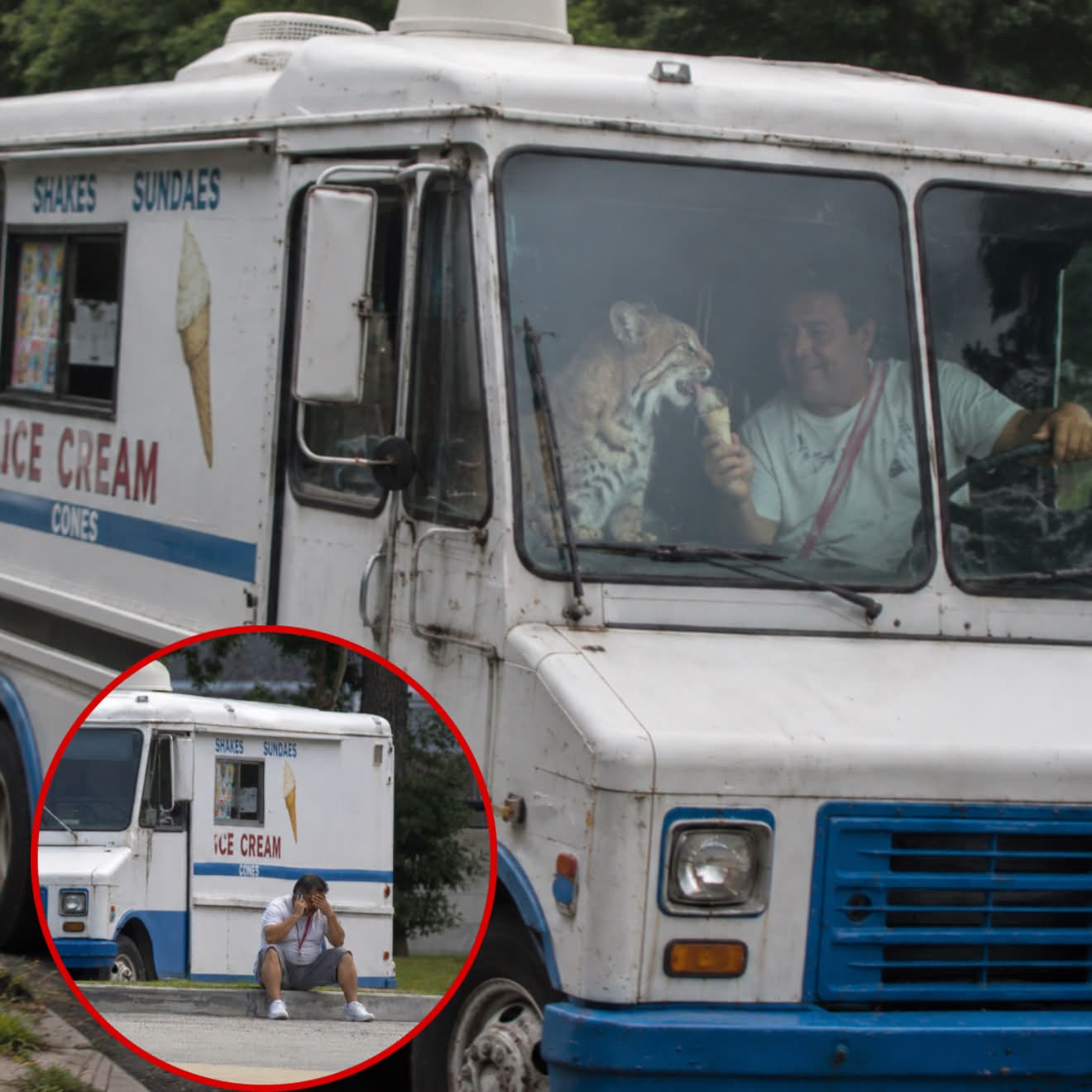
Taken through the windshield. The lynx on the passenger floor in the delivery blanket. Milo behind the wheel, eyes fixed ahead, one hand extended toward the animal. On the dashboard, the ice cream cone sat tipped slightly to one side, white cream melting into a napkin.
It looked tender.
It looked terrible.
“You transported a wild animal in company property,” his supervisor said.
Milo rubbed both palms down his apron. They still smelled faintly of dust and vanilla.
“It was in the road.”
“You know the rules.”
“There wasn’t time.”
“That’s not your call.”
Milo stared at him. The words arrived slowly, each one like a spoon dropped onto tile. Not your call. Company property. Misconduct. Liability. The kind of words that had clean shoes and never knelt on hot gravel.
“So that’s it?” Milo asked.
His supervisor looked away first. “Clean out your locker.”
Milo did not argue. Maybe he should have. Maybe a different man would have shouted, thrown the keys, made everyone in the depot hear exactly what a rule was worth beside a living thing lying in traffic.
But Milo was tired.
He took his cap from the hook, folded his apron, and placed both on the metal shelf. In the parking lot, evening insects had begun ticking in the grass. He stood there for a minute with his empty hands hanging at his sides.
By the next morning, the photo was everywhere.
People came to his small apartment with bread, with coffee, with envelopes they tried to press on him until he stepped back and shook his head. Mothers whose children had bought ice cream from him for years stood on the walkway talking over one another.
“They can’t just—”
“We called them.”
“My brother knows someone who—”
Milo kept saying, “Please, it’s all right,” though it wasn’t.
Near noon, the woman from the rehab center arrived.
She did not bring the lynx, of course. Milo was embarrassed that some small, foolish part of him had hoped to see those tufted ears again.
Instead, she held out her phone.
A video played.
The young lynx was in a shaded enclosure, crouched beside a bowl, blinking slowly at the camera. Its fur had been brushed clean of dust. One ear twitched as someone offscreen moved, and the animal lifted its head with a small spark of irritation that made Milo’s throat tighten.
“He’s still grumpy,” the woman said.
Milo swallowed. “Good.”
“Grumpy is good.”
The crowd behind him went quiet.
The lynx turned away from the camera and stepped into the shade, tail bobbing once before the video ended.
Milo handed the phone back carefully.
That afternoon, the children painted a cardboard sign and taped it to the wall outside his building. The letters were crooked, dripping blue at the edges.
THANK YOU, ICE CREAM MAN.
Someone had drawn a spotted cat beside the words, much too round, with enormous paws and a cone floating near its nose.
Milo stood in front of it until the tape began peeling in the heat.
Then the little boy from the road came up beside him, the same one who had first called it a cat. He held out a coin.
“For when you get a truck again,” he said.
Milo looked down at the coin in the boy’s dusty palm.
He almost told him to keep it.
Instead, he closed the boy’s fingers around it and bent to meet his eyes.
“First one’s on me,” Milo said.
The boy grinned and ran off before he could change his mind.
That evening, Milo sat on the curb beneath the sign while the sky turned soft and orange. Somewhere beyond the buildings, an ice cream truck from another route played its bright little song, thin and distant.
Milo listened until it faded.
Then he took the melted cone wrapper from his shirt pocket, folded it once more along the crease, and tucked it carefully back inside.
 StoryTime