

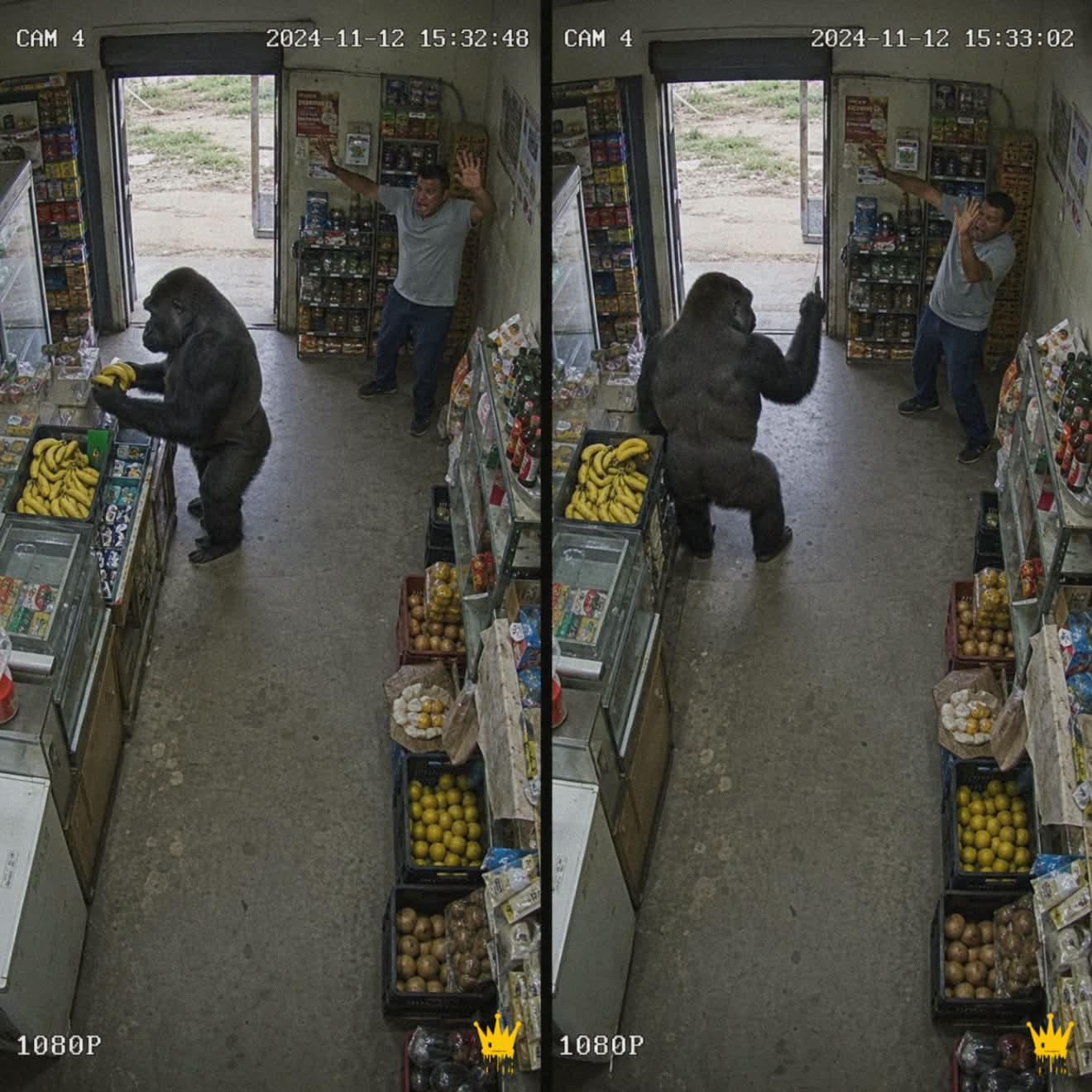
The bell above my shop door gave one soft, nervous jingle, and when I looked up from tying the bread sacks, a gorilla stood in the doorway.
For a moment, neither of us moved.
Morning light came in behind him, thin and gold, cutting around his huge shoulders. Dust floated between us. Outside, a rooster made a cracked little sound and then went quiet, as if even he had decided not to interrupt.
I still had a length of string between my teeth.
The gorilla blinked at me.
I had seen gorillas before, but always far off, dark shapes behind leaves, their backs shining after rain. You heard about them, mostly. A bent branch. A footprint in mud. A story from someone’s cousin who swore one had watched him from the trees while he cut grass.
But this one was inside my shop, filling the doorway as if he had come to buy salt.
“Eh,” I said, because fear makes a man stupid. “No. No, no. Go.”
He stepped in.
The floorboards complained under him.
My little shop was not much more than two aisles and a counter. Soap stacked beside cooking oil. Flour in blue sacks. A crate of tomatoes that were already too soft on one side. At the front, beside the scale, hung the bananas I had brought in before sunrise, still green at the tips, smelling sweet and damp from the basket.
The gorilla turned his head.
He had not come for soap or flour.
His eyes found the bananas at once.
“No,” I said again, louder this time, though my voice broke in the middle. “Go back. Shoo.”
I picked up the broom from beside the counter and held it across my chest like a spear. It was a ridiculous thing to do. The broom had lost half its bristles and bent every time I swept the doorway. Still, it was the only brave-looking object within reach.
The gorilla looked at the broom. Then he looked at me.
I lowered it a little.
Outside, a woman gasped. Someone whispered my name. A child giggled once and was hushed so sharply that the sound vanished.
The gorilla walked past the shelf of cassava flour with slow, heavy steps. He did not smash anything. He did not bare his teeth. He did not roar. His knuckles touched the floor in a careful rhythm, and his nostrils widened as he breathed in the smell of ripe fruit.
He stopped under the bananas.
I should have run out the back. I should have climbed onto the sacks. I should have done many things a clever man would later claim to have done in my place.
Instead, I shouted, “Hey!”
The gorilla reached up.
One banana came loose with a soft snap.
Just one.
Not the whole bunch. Not the basket under the counter. One banana, curved and yellow, held gently in fingers thick as plantain stems.
My shouting had brought half the village to the doorway, though nobody came close. I saw faces pressed behind the window bars, eyes wide, mouths open. Old Nuru stood near the water drum, one hand on her chest. A boy named Kato crouched behind her skirt, peeking around her hip like this was a puppet show and not a gorilla stealing my breakfast stock.
“Put it down,” I said.
The gorilla turned.
His face was not angry. That was the strangest part. If he had looked wild, if he had charged or thrown the shelf against the wall, I could have wrapped the whole thing in fear and understood it that way.
But he looked tired.
There was dirt clinging to one shoulder. A burr caught in the hair near his jaw. His lower lip hung slightly open, and he chewed nothing, just moved his mouth as if remembering food.
Then he lifted his hand.
At first I thought he was warning me away. His palm came up slowly, broad and dark, with one long finger raised higher than the others.
Behind me, someone choked on a laugh.
The gorilla held the gesture for one breath, maybe two.
Then he turned his back on us and walked out of the shop with the banana.
The village burst open.
Kato laughed so hard he fell sideways against the water drum. Nuru slapped his shoulder and laughed too, though she tried to hide it behind her wrapper. Men came from the roadside with their phones already in their hands, asking me to show them where I had stood, how close he had been, whether I had seen the finger clearly.
“He insulted you,” one said, grinning.
“He paid you with respect,” another told me. “That is worth more than coins.”
“He did not pay at all,” I snapped, but I was shaking so badly I had to sit on the stool behind the counter.
The bananas swayed on their hook.
Only one was missing.
By noon, everyone had a version. In one, the gorilla had knocked on the door first. In another, I had wrestled him for the banana. By evening, children were walking past my shop with their fingers tucked wrong in their fists, howling with laughter until their mothers caught them.
I laughed too, at first.
What else could I do?
It was easier to laugh than to think about the way he had moved.
Not like a thief.
Like someone who knew this place was not his, but hunger had pushed him through the door anyway.
That night, after I closed the shop, I sat on the step and looked toward the forest line. The sky had gone purple behind the hills. Smoke from cooking fires slipped low over the road. Somewhere beyond the fields, branches snapped in the dark.
My wife, Amina, came with two cups of tea and sat beside me.
“You are famous,” she said.
“I am robbed.”
“One banana.”
“A fine banana.”
She handed me my tea. “You saw his face.”
I did not answer.
She leaned her shoulder into mine. “What was it like?”
I watched a moth throw itself again and again at the shop lamp.
“He knew where to look,” I said.
“For bananas?”
“For food.”
Amina was quiet.
We both knew things had changed, though people liked to say change came slowly. It did not feel slow when the trees disappeared from a hillside in one dry season. It did not feel slow when animals started crossing the road at dusk, thin and confused, sniffing at rubbish pits and garden fences.
My father used to say the forest had moods. It could be generous or closed, noisy or watchful. Now, some mornings, it looked less like a forest and more like a wound someone had tried to cover with mist.
The next day, the laughing continued.
A man from another village came just to buy salt and ask if this was “the gorilla shop.” Children drew pictures in the dust: me with a broom, the gorilla with a banana, the finger always much too long.
I let them laugh.
But when I hung the new bananas, I tied one lower than the rest and left it near the doorway.
“Are you mad?” Amina asked when she saw it.
“It is bruised,” I said.
“It is perfect.”
“For a customer with long arms.”
She gave me a look, but she did not move it.
Three mornings passed.
On the fourth, the bell did not ring.
I was pouring beans into a sack when the outside voices thinned. That was how I noticed first: not a sound, but the sudden absence of ordinary noise.
I looked up.
He stood at the edge of the road, half in sunlight, half in the shade of the leaning tree.
The same gorilla.
At least, I believed it was him. The burr was gone from his jaw, but there was the same worn heaviness around his eyes, the same patient way of standing as if the world had become inconvenient and he was waiting for it to move.
Nobody laughed.
The children watched from behind doorways. Amina came from the house with flour still on her hands.
The gorilla stared at the shop.
I stepped outside slowly, both hands empty.
My heart was beating hard enough to make my shirt jump.
“You,” I said, softly.
His nostrils moved.
The low banana hung beside the door, yellow now, freckled brown. The breeze turned it a little on its string.
The gorilla walked forward.
I backed away, one careful step, then another. Not running. Not shouting. The village held its breath around me.
He reached the doorway and stopped.
His hand rose.
For one wild second, I thought he would make the same rude little sign and send the whole village screaming with laughter again.
Instead, he took the banana.
The string snapped.
He held it close, looked at me, and made a low sound in his chest. Not thanks. Not apology. Nothing so human as that.
Just a sound.
Deep, rough, alive.
Then he turned toward the forest.
This time, no one followed with phones. No one called after him. We watched him cross the road, pass the dry ditch, and step into the tall grass where the trees began.
When he vanished, Kato crept up beside me.
“Will he come again?” he whispered.
I looked at the empty string by the door, still swinging.
“I don’t know,” I said.
That evening, I moved the banana hook outside, under the roof where the rain could not reach it. Amina stood beside me, her arms folded, pretending she disapproved.
The next morning, before opening the shop, I hung one ripe banana from the lowest loop.
Then I swept the step clean and left the door open.
 StoryTime