

The first thing I heard wasn’t the crack of the windows or the groan of the roof.
It was a boy screaming, “Biscuit’s still in there!”
He was standing barefoot in the street, wrapped in a blanket that kept slipping off one shoulder. His face was streaked black with smoke and tears, and every time someone tried to lead him farther away, he twisted back toward the house like there was a rope tied between him and the flames.
“Please,” he kept saying. “He hides in the bathroom. He always hides in the bathroom.”
The house was already breathing fire through the front windows when we pulled up. Heat rolled over the lawn hard enough to make the shrubs shiver. Orange light jumped behind the curtains. Somewhere inside, something heavy fell and sent sparks coughing through the broken doorway.
I had been in enough fires to know when a house was done fighting to stay whole.
I had also been in enough homes to know dogs.
They don’t understand orders. They don’t know what a collapse warning means. They run from the noise, from the masks, from the monsters in helmets breaking through doors, and they wedge themselves into the smallest dark place they can find.
“Name?” I shouted through my mask.
The boy blinked at me like he’d forgotten words.
“Your dog’s name.”
“Biscuit,” he said. Then, quieter, like he was afraid the fire might hear it too. “He’s yellow. He has one ear that sticks up.”
I looked at the doorway, then at my captain.
“We’ll sweep what we can,” he said.
That was not a promise. It was the closest thing we were allowed to give.
Inside, the air was thick and mean. Smoke turned my flashlight into a dull white coin in front of me. I could hear the hose team somewhere to my left, boots dragging over broken glass, someone calling out room checks in a voice that stayed calm because it had to.
“Biscuit!” I yelled.
My own voice bounced back at me, strange and swallowed.
The living room was empty except for a toppled chair and a scatter of family photographs facedown on the floor. In the hallway, heat pressed down from above. The ceiling had started making that low, dangerous ticking sound, little warnings hidden inside bigger noise.
I got down lower, sweeping under furniture, behind doors, anywhere a frightened dog might fold himself.
“Biscuit!”
A child’s backpack lay half melted near the stairs. One strap still had a little plastic rocket clipped to it. I thought of the boy outside, barefoot on cold pavement, saying the bathroom like it was a map only Biscuit knew.
Over the radio, my captain’s voice cut in.
“Interior crews, conditions worsening. Finish your sweep and back out.”
I crawled deeper.
The first bathroom was clear. Towels on the floor. Mirror cracked in a spiderweb across the sink. No dog.
I turned toward the back hallway, where the smoke was thicker.
“Reed,” my partner called from somewhere behind me. “We need to move.”
“Check the last bath,” I said.
“What?”
“The kid said he hides in the bathroom.”
A pause. Then, “Make it fast.”
There are moments in a fire when time becomes small and sharp. You stop thinking about the whole house. You think about three feet of floor, one doorway, one breath of air left in your tank. You think about the sound your boots are making. You think about the roof, and you don’t look up too long.
The second bathroom door was almost closed.
I shoved it open with my shoulder.
At first, I saw nothing but gray, the bathtub a pale shape under the smoke. I swept my light across the floor, the toilet, the cabinet hanging open. My glove hit something soft near the base of the tub.
Then I saw the ear.
One ear up. One ear folded flat.
Biscuit had jammed himself into the narrow space between the tub and the wall, his body pressed so tight he looked smaller than he could possibly be. He was a yellow dog, or had been before the smoke dirtied his fur. His eyes reflected my light, wide and wet and terrified.
“Hey, buddy,” I said, and my voice broke in the mask. “There you are.”
He didn’t come to me. Of course he didn’t. To him I was noise and glass and strange rubber breathing.
I reached slowly.
He flinched.
“I know,” I said. “I know, I know. We’re leaving.”
The radio snapped again, louder this time.
“All interior crews, evacuate. Evacuate now.”
The tone followed. That long, ugly sound every firefighter knows in the bones.
My partner’s voice came next. “Reed, move!”
I could have backed out then.
That is the part people argue about later, over kitchen tables and in comment sections and in rooms where no smoke is pressing against the door. I could have said I tried. I could have said the conditions changed. I could have carried that boy’s face with me for the rest of my life and still kept my job.
Instead I wedged my arm behind the tub and got one hand under Biscuit’s chest.
He coughed, a rough, small sound that made my decision feel less like bravery and more like being unable to do anything else.
“Come on,” I muttered. “Help me out.”
He was heavier than he looked. Dead weight with fear in it. I pulled him free, tucked him against my coat, and turned back into the hallway just as a section of ceiling came down behind us with a roar that knocked me to one knee.
The whole house seemed to inhale.
For one second, I couldn’t see the way out.
Then my partner’s light cut through the smoke.
“Reed!”
“Got him!” I shouted.
He swore once, not angry exactly, just scared enough that it came out that way.
We moved low and fast. Biscuit’s head bumped weakly against my arm. I could feel him trying to breathe, little catches through his ribs. My alarm was screaming. My tank was running thin. The front door looked impossibly far away, a rectangle of dirty gold.
Hands grabbed my coat. Someone hauled me over the threshold. Cold air struck my facepiece.
The boy saw the dog before anyone said a word.
“Biscuit!”
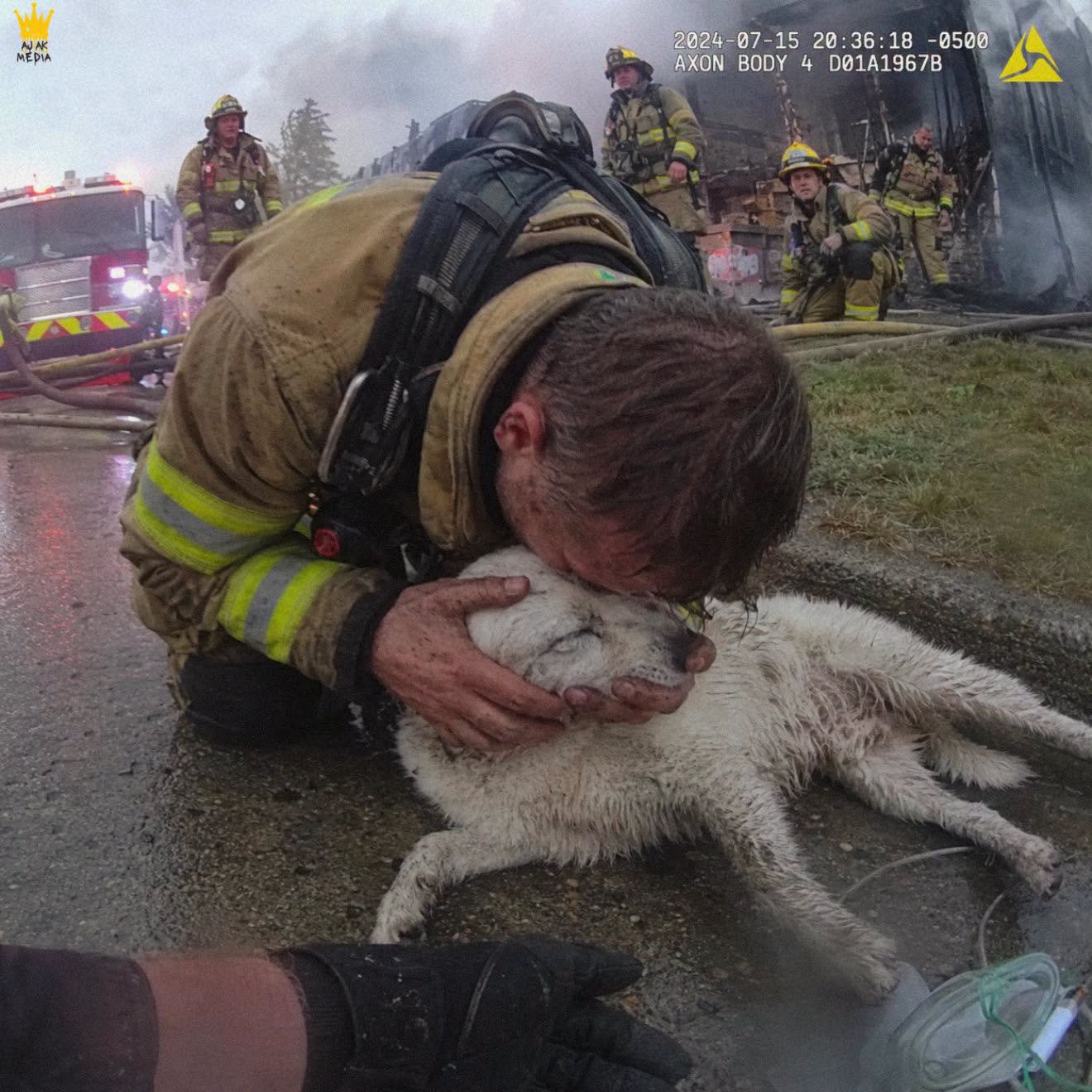
I dropped to my knees on the grass and laid him down. He coughed once, then went frighteningly still.
“No, no, no,” the boy whispered.
Someone brought a pet oxygen mask from the rig. I fitted it gently over Biscuit’s muzzle, my gloves clumsy around his soft, smoke-wet fur.
“Come on, boy,” I said. “You made it this far.”
His chest barely moved.
The family huddled behind us, the mother holding her son so tightly his blanket bunched under her hands. The father had one palm pressed over his mouth. Nobody was praying out loud, but the silence felt like a prayer.
A medic knelt beside me.
“I’ve got him,” she said.
I shifted back, though every part of me wanted to keep a hand on Biscuit, to hold him to the world by touch alone. The medic worked with practiced calm, adjusting the mask, checking him, calling for another piece of equipment in a voice that did not shake.
The boy sank onto the curb.
I sat beside him because my legs had decided they were finished.
“Is he—” The boy couldn’t finish.
“They’re helping him,” I said.
It was the only honest thing I had.
The house behind us cracked and sighed. Flames pushed up through the roof, bright against the night. My captain stood a few yards away, his face unreadable beneath the soot, watching the medics, watching me, watching the roofline like it might still take more from us.
Then Biscuit coughed.
Not a big movie kind of moment. Not a leap to his feet. Just one rough, wet cough under the clear mask.
The boy made a sound I will never forget.
Biscuit’s paw twitched. His folded ear gave the smallest jerk. The medic looked up, and for the first time all night, she smiled.
“There he is,” she said.
The boy fell forward onto his knees, but his mother held him back gently.
“Give them room, honey.”
“I’m here, Biscuit,” he said, crying so hard the words came out broken. “I’m right here.”
Biscuit’s eyes opened halfway. I don’t know if he saw the boy. I like to think he did, because his tail moved once against the grass.
Two days later, I turned in my gear.
Not forever, they told me at first. Just while they reviewed what happened. Then the words got cleaner and colder. Violation. Disobeyed a direct order. Created risk for additional crew.
I stood in a small office with smoke still caught in the cracks of my hands and listened to men who had never heard that boy scream explain the shape of my mistake.
They weren’t entirely wrong.
That was the worst part.
An order in a burning house is not a suggestion. When one firefighter stays, others may go after him. A choice can be made with a full heart and still put everyone else in danger.
I knew that. My crew knew that.
But when I came out of the office, they were waiting by the lockers.
My partner was leaning against the wall, arms crossed, eyes red from lack of sleep.
“You’re an idiot,” he said.
“I know.”
He nodded once. “But you’re our idiot.”
Nobody made a speech. Firefighters are not as good at speeches as people think. One of them put a cup of coffee in my hand. Another clapped my shoulder hard enough to hurt. My captain stood at the end of the row for a long moment before he said, “You scared the hell out of us.”
“I’m sorry.”
He looked away first.
Word traveled faster than I expected. Not the polished version. The real one, lopsided and full of arguments. Some people said I should have followed orders. Some said any person who would leave a dog behind didn’t deserve the uniform. Both sides yelled as if fire had ever been simple.
Then the crew spoke.
Not on stages. Not with grand declarations. They wrote statements. They answered questions. They said I had been reckless, yes, but not careless. They said Biscuit was a life in that house. They said discipline mattered, and so did mercy.
The boy’s family sent a photo.
Biscuit was wrapped in a blue towel, sleeping on a couch with his head in the boy’s lap. One ear stood straight up. The other rested against the boy’s knee. On the back, in crooked handwriting, it said:
He still hides during storms, but now he comes out when we call.
I kept that photo in my glove compartment.
When I was allowed back, I didn’t walk into the station like a hero. I walked in embarrassed, grateful, and carrying doughnuts because it seemed safer than trying to say everything.
My partner took the box from me.
“Don’t do that again,” he said.
“The doughnuts?”
“You know what I mean.”
Across the room, my captain glanced at me over his coffee.
“Gear’s where you left it.”
That was all.
A week later, just after sunset, a small car pulled up outside the station. The boy got out first, dragging his mother by the hand. Biscuit jumped down after him, moving slower than a dog his age should, but moving.
His yellow fur had grown clean again. His one ear still stood up like a question.
He saw me and stopped.
For a second, neither of us moved.
Then his tail began to thump against the side of the car.
The boy unclipped his leash, and Biscuit trotted across the concrete, straight past the rigs, straight past my crew, and pressed his smoky, stubborn head against my knees.
I crouched down and put both hands in his fur.
“Hey, buddy,” I said.
Biscuit leaned harder, as if he had been looking for the safest place in the room and had finally chosen one.
 StoryTime