

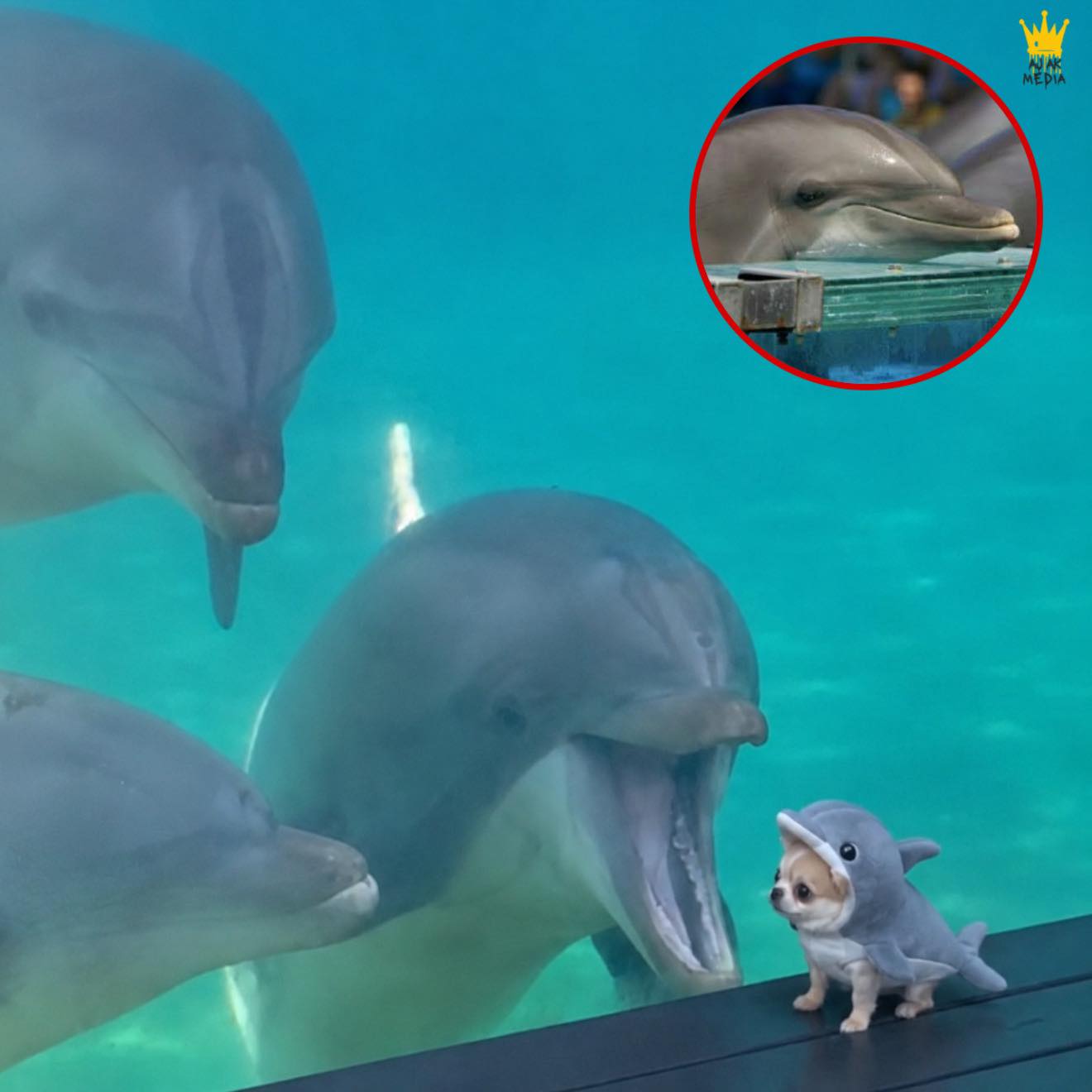
The first sound was so small I almost missed it—a single click from the deepest end of the pool, sharp as a pebble tapping glass.
I looked up from the feed chart.
“Did you hear that?” I asked.
Marin, beside me, froze with a bucket against her hip. For nearly a week, the dolphins had moved through the water like shadows that had forgotten what sunlight was. They ate when they had to. Surfaced when they had to. Drifted, mostly, in a loose cluster near the bottom where the blue deepened and the overhead lights turned pale and wavering.
Another click came.
Then a whistle.
I followed Marin’s stare toward the public viewing window, where a woman stood with a small dog tucked in the crook of her arm.
Not just any dog.
A tiny tan Chihuahua with enormous worried eyes and a soft gray costume wrapped around its body. A little fin stood up crookedly from its back. Two floppy side fins hung by its ribs. The hood, which had slipped halfway behind one ear, was shaped like a dolphin’s head.
For one ridiculous second, nobody moved.
Then Mira, our oldest female, lifted from the bottom and swam straight toward the glass.
She didn’t rush. Dolphins rarely do when they’re thinking. She rose with slow, deliberate strokes, her pale belly flashing once as she turned. The others hesitated behind her. Rio stayed low. Cal made a half circle, uncertain.
But Mira kept going.
The woman with the dog laughed softly, not realizing what had just happened. “Look, Peanut,” she murmured. “Friends.”
Peanut blinked at the glass.
Mira stopped inches from him.
Her eye fixed on the dog with such clean, bright focus that I felt something catch in my throat.
“Lisa,” Marin whispered, “they’re looking.”
I was already stepping closer.
For days, we had tried everything we were allowed to try. Floating rings. Puzzle feeders. Kelp streamers that should have made Cal wild with excitement. New trainer positions. Softer whistles. Longer pauses. Quiet mornings with no visitors near the glass. We had changed the rhythm of feeding, the toys, the music we sometimes played low near the staff corridor.
The dolphins noticed all of it and cared about none of it.
They had come to us after a long, grim recovery elsewhere, their bodies stronger than they had been but their spirits harder to read. The move had undone something. Not their health exactly, though we watched that closely, but their spark. They seemed present and unreachable, like someone sitting in the same room with you and staring through the wall.
I had written in the log the day before: alert, responsive to surfacing cues, limited social play.
Then, after staring at those words too long, I’d added in the margin where no form asked for it: They feel gone.
Now Mira was floating upright before a Chihuahua in a dolphin suit.
Peanut’s nose twitched.
Mira clicked again.
At the sound, the dog jerked back against the woman’s chest and let out one tiny, offended bark.
The whole dolphin pool woke.
Rio shot upward from the bottom so fast his wake slapped the side wall. Cal came next, spinning once as if he had forgotten his own body could do that. Sula and Bee slipped into the space beside Mira, pressing close enough that their sides brushed. Five bottlenose dolphins gathered at the glass, eyes bright, heads tilting, bodies hovering in that effortless way that always made me jealous of water.
Visitors along the railing began to notice.
“Mom, look,” a child said.
Marin put the bucket down very slowly, as though any sudden movement might break whatever strange spell had opened in front of us.
Peanut barked again. A thin, squeaky sound, more question than threat.
Cal answered with a burst of clicks so quick it sounded like rain on tin.
The dog’s ears lifted.
“Oh my goodness,” the woman said, laughing now, a hand pressed over her mouth. “He thinks they’re talking to him.”
Maybe they were.
I knew better than to make pretty claims out of animal behavior. I knew how much harm people could do by deciding a wild creature was smiling, grieving, thanking, loving, forgiving, based only on what we wanted to see. Our work was patience and restraint. We observed. We recorded. We did not turn mystery into certainty because it made a better story.
But I also knew their faces.
I knew the slack quiet they had worn all week, and I knew what it looked like when a dolphin became interested in the world again.
Mira dipped below the window and rose with a bubble trail streaming from her mouth.
Peanut leaned forward.
The woman tightened her hold. “Nope, little man. You are not going swimming.”
Marin let out a laugh that cracked at the edges.
Bee rolled sideways, one eye still on the dog, and slapped her fluke lightly against the surface. Not hard. Not anxious. A playful, testing motion that sent a small fan of water against the inside of the glass.
Peanut yipped and tucked his chin into the costume hood.
Cal spun.
Rio whistled.
The sound filled the room.
It wasn’t loud in the way people think of loud. It was layered—clicks, chirps, whistles rising and falling, bouncing against glass and tile, passing through the soles of my shoes. It felt less like hearing and more like standing inside a thought too quick for words.
A junior volunteer hurried in from the side door, eyes wide. “What happened?”
“Dog,” Marin said.
“What?”
“Dog,” she repeated, pointing.
The volunteer looked from the dolphins to Peanut and back again. “Seriously?”
I couldn’t stop watching Mira. She had been the one I worried over most. The others sometimes copied her stillness, circling down when she sank, ignoring toys when she ignored them. If the group had a door, Mira seemed to be the one standing behind it, refusing to open.
Now she was pressing close to the glass, tracing the dog’s movements as the woman shifted him from one arm to the other.
Peanut, perhaps encouraged by the attention, put both front paws against the woman’s wrist and stared back.
His costume fin tilted sadly to one side.
“Do you mind staying there a minute?” I asked the woman, keeping my voice gentle. “Only if he’s comfortable.”
She looked startled to be addressed by staff. “Oh. Sure. He’s fine. He likes attention. Too much, probably.”
“What’s his name?”
“Peanut.”
Of course it was.
I crouched near the glass, not between them, just close enough to see what the dolphins did when the dog moved. Peanut turned his head. Five heads turned with him. Peanut licked his nose. Bee clicked. Peanut sneezed, and Cal jerked backward before sweeping into a half-spin that made the child at the railing squeal.
The woman laughed harder. “He sneezed at you. That’s all.”
For nearly ten minutes, the pool belonged to a dog smaller than one of Mira’s flippers.
Then Peanut began to squirm.
His owner shifted her bag. “We should go. He’s had a big day.”
I wanted to ask for another minute. Another five. I wanted to memorize every sound, every bright turn, every quicksilver flash of movement, because part of me feared they would sink again the moment the dog left.
But Peanut was not a tool. He was a little dog in a silly costume, blinking under fluorescent light.
“Thank you,” I said. “Really.”
The woman softened. “They liked him, huh?”
Mira hovered at the glass.
“Yes,” I said. “They did.”
Peanut disappeared down the corridor, one gray fin bobbing above the woman’s arm until the corner took him.
For a moment, the dolphins stayed where they were.
Then Rio nudged the floating ring nearest the wall.
Not much. Just a bump.
Cal bumped it back.
Marin covered her face with both hands.
I pretended not to see.
That evening, I wrote the longest behavior note I had written in days. I kept it careful: increased vocalization in response to unfamiliar small animal at viewing window; sustained visual tracking; social grouping near glass; post-event object interaction observed.
Then, below the clean professional lines, I wrote one more sentence.
They came up.
The next morning, Mira took a fish from my hand without making me wait. Cal chased a rubber ball, abandoned it, then returned as if surprised it was still fun. Bee began carrying a strip of kelp around like a prize. Rio answered whistles more quickly. Sula, who had been the quietest of all, startled everyone by tossing a ring over the divider rope and looking immensely pleased with herself.
No one said Peanut had fixed them.
Animals are not locks, and joy is not a key you can buy in a gift shop.
Still, we talked about him constantly.
“Maybe it was the shape,” Marin said while rinsing buckets. “Small moving thing. Weird outline.”
“Maybe the fin,” I said.
“Maybe they thought he was the ugliest dolphin alive.”
I laughed so suddenly water splashed down my sleeve.
A few days later, an envelope arrived at the front desk. Inside was a printed photo of Peanut in his costume, standing on a sofa with the solemn expression of a creature burdened by fame. On the back, his owner had written: For his dolphin friends.
We taped it inside the staff room, above the sink where everyone would see it.
By the time the dolphins were ready for open water again, their bodies had filled out and their movements had sharpened into something confident. On their last morning with us, the sky was soft and colorless, and the sea beyond the transport gates breathed in slow gray folds.
Mira entered the sling without panic. Rio whistled once from the water beside her. Cal splashed a trainer hard enough to soak his shirt, which felt like a farewell and an insult at the same time.
Before they left, I slipped into the staff room and took down the photo.
I carried it to the pool window.
“This is ridiculous,” Marin said behind me.
“I know.”
I held Peanut’s picture up to the glass.
Mira surfaced once, close enough that her breath fogged the air between us.
Then she turned, joined the others, and the water closed over all five shining backs.
 StoryTime