

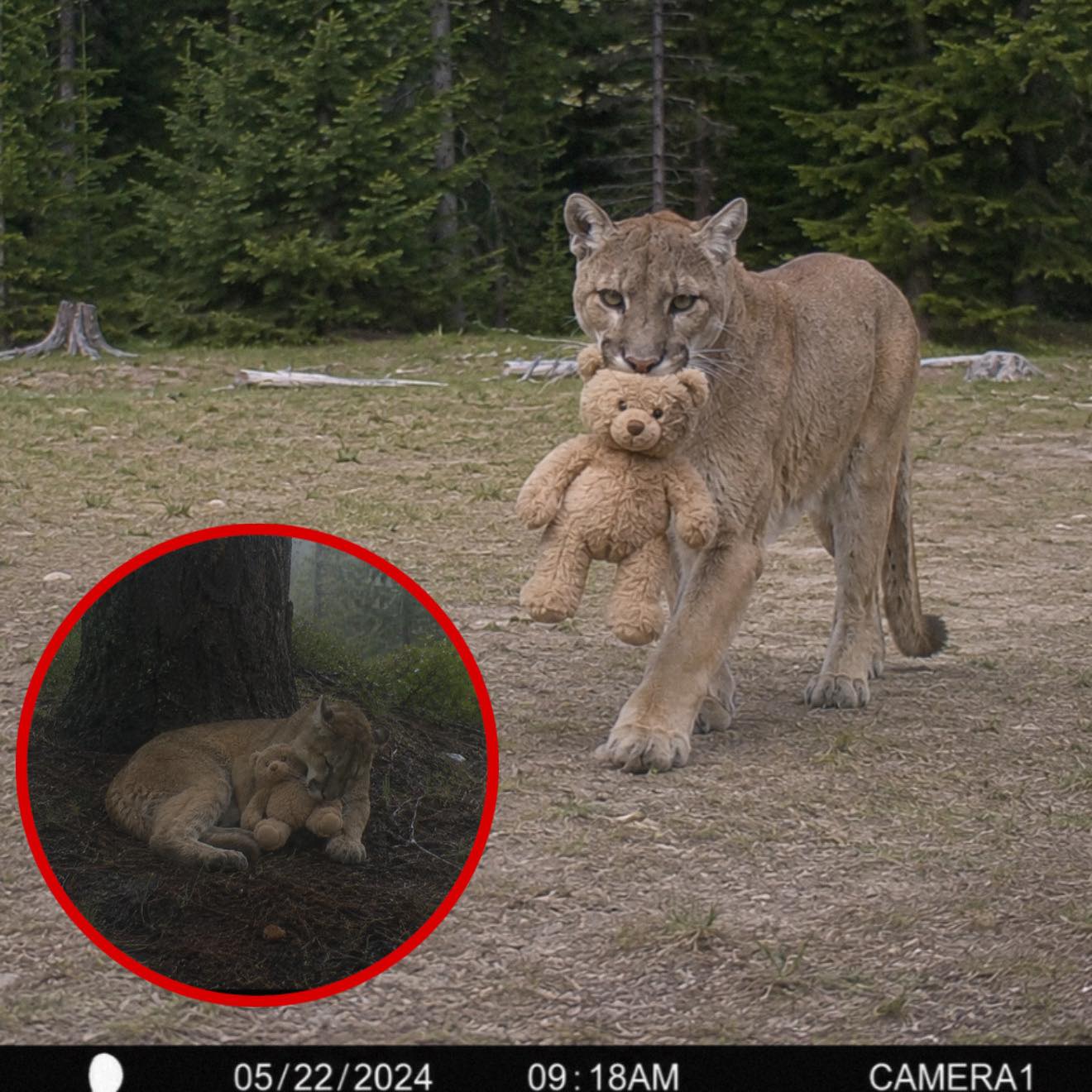
After losing her cub in a roadside accident, a tagged cougar in the Pacific Northwest displayed behavior that left researchers deeply unsettled
Wildlife researchers in the Pacific Northwest were left searching for answers after an unusual series of images emerged from their tracking data. A female mountain lion, already known to the team through her GPS collar, had recently lost her only cub in a tragic accident. The young animal had been struck and killed while attempting to cross a rural highway, a growing risk as human infrastructure continues to fragment natural habitats. In the days that followed, her movements told a troubling story. Her GPS signal remained almost entirely fixed near the roadside for nearly five consecutive days, suggesting she had stayed close to the exact location where the incident occurred, barely moving at all.
When biologists were finally able to locate her, the situation appeared critical. According to field observations, the cougar was dangerously thin, showed little to no interest in food, and displayed behavior that suggested extreme stress or disorientation. For a solitary predator that depends on strength and precision to survive, this kind of decline is often a sign that recovery is unlikely. Over the following weeks, her movements remained slow and inconsistent, reinforcing concerns that the loss of her cub had deeply affected her ability to function in the wild.
Then, about a month later, trail cameras began capturing something no one on the team had ever seen before. The same mountain lion reappeared, but this time she was not alone. Held gently in her mouth was a small, worn teddy bear. The footage showed her moving through the forest with it, carefully carrying it from place to place. On multiple occasions, she was seen lying down and curling her body around the object in a protective position, mirroring the posture typically observed when a mother rests with her cub. The behavior was consistent across several nights and different locations, leaving little doubt that the object had taken on a specific role for her.
Researchers remain cautious about drawing definitive conclusions, but some believe this may represent an extreme behavioral response to loss. The teddy bear, likely found near a human area, appeared to act as a substitute for the cub she had lost. One tracker, after reviewing hours of footage, noted that she handled it with the same care and attention expected toward a living offspring. While it is difficult to interpret the inner experience of a wild animal, the sequence of events has sparked serious discussion among specialists. What remains undeniable is the image itself, a solitary mountain lion moving quietly through the forest, carrying something that seemed to hold far more meaning than it should.
 StoryTime