

A strange baby monitor alert led to a discovery that left even wildlife experts searching for answers.
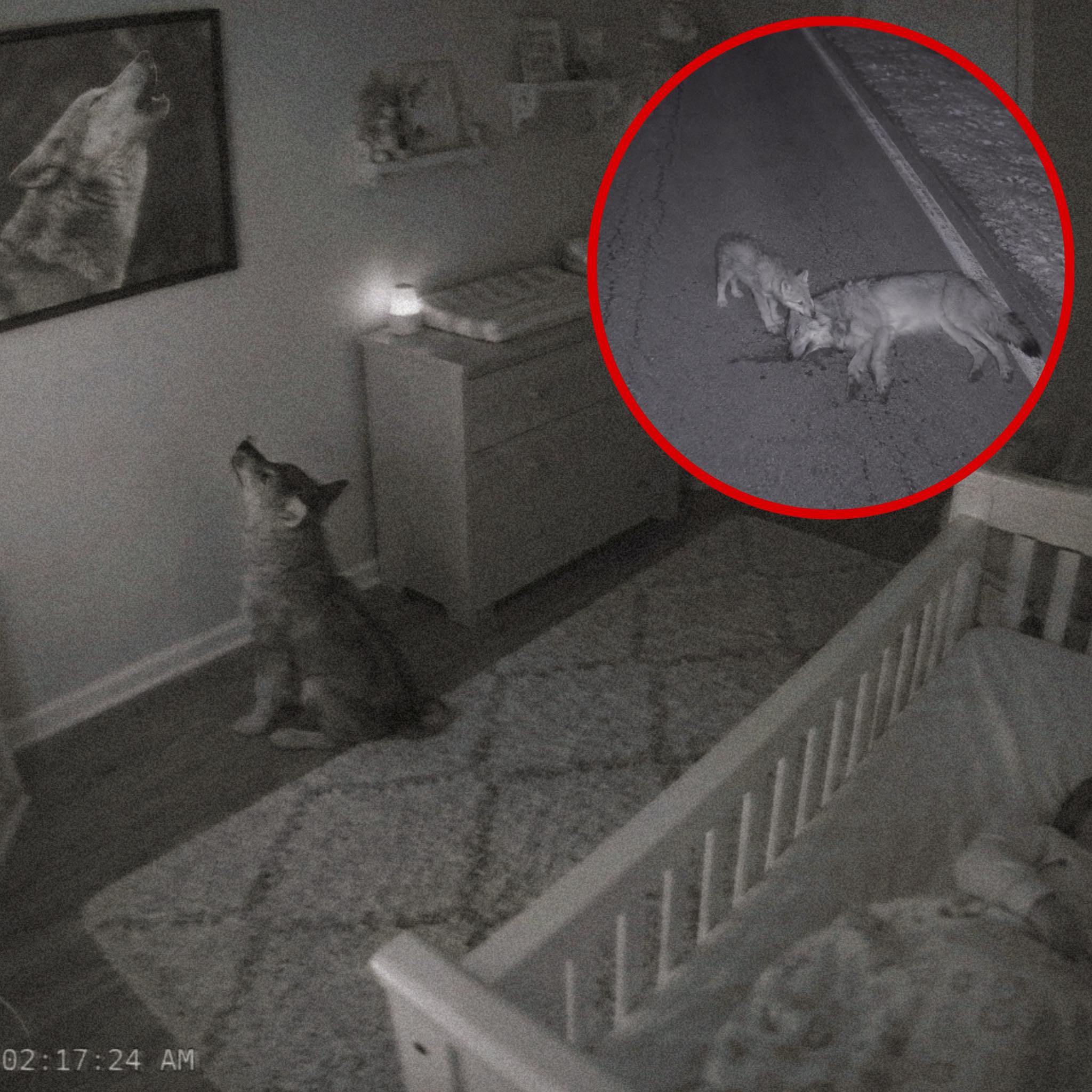
A family woke up in the middle of the night to a motion alert from their baby monitor and immediately rushed into the nursery, expecting to find their child awake.
Instead, they stopped cold.
Standing quietly inside the room was a small wolf pup.
It wasn’t moving, wasn’t making any noise, and didn’t appear aggressive. It was simply standing there, completely still, staring at something on the wall.
The parents quickly realized the pup’s attention was fixed on a framed photograph of a wolf hanging above a dresser.
Without taking any risks, they grabbed their baby and slowly backed out of the room before calling animal control. Officers arrived shortly after and were able to safely remove the pup without any resistance. It was then transported to a nearby wildlife rehabilitation center.
At first, the situation didn’t make much sense.
There were no obvious signs of forced entry, and it wasn’t clear how a wolf pup had managed to get inside the house, let alone into a nursery. What stood out even more was its behavior—it hadn’t explored the room, hadn’t approached the crib, and hadn’t shown any signs of panic.
It had only been staring at the photograph.
The footage from the baby monitor was later reviewed, and it confirmed the same thing. For several minutes, the pup remained in the exact same position, focused entirely on the image on the wall.
That detail caught the attention of a wildlife behavior researcher, who decided to look deeper into what might explain such an unusual reaction.
After checking recent reports in the area, the researcher found that about a week earlier, a female wolf had been killed in a hit-and-run accident not far from the family’s property. The location of the incident suggested that the animal had been living nearby, possibly with a den in the surrounding area.
Based on typical behavior, it was likely that she had at least one pup.
The timing raised questions.
To explore the possibility further, the researcher compared available images of the deceased wolf with the framed photograph inside the nursery. While not identical, the similarities were noticeable—especially in the markings around the face and the overall structure.
According to the researcher, the resemblance could be estimated at around 80%.
That’s when a possible explanation began to take shape.
After losing its mother, the pup may have been wandering alone in the area, potentially returning to familiar zones near its original habitat. At some point, it could have passed near the house and noticed the image through the window.
From a distance, certain visual cues—like shape, contrast, and facial markings—might have appeared familiar enough to trigger recognition.
Driven by that perception, the pup may have approached the house and eventually found a way inside.
What remained unusual was its behavior once inside.
It didn’t search for food.
It didn’t react to human presence.
It didn’t attempt to hide or escape.
It simply stood there, focused on the image.
In wildlife behavior, young animals that lose a parent can sometimes display disoriented or repetitive patterns, especially in the days following the loss. While it’s difficult to assign intention, experts note that visual recognition plays a role in how some animals identify others, particularly in close-range or familiar contexts.
In this case, the photograph may have acted as a visual trigger.
The pup is currently being cared for at a wildlife center, where specialists are monitoring its condition and behavior. The goal is to stabilize it and, if possible, reintroduce it into a suitable natural environment.
As for the family, they have since returned to their home, but the experience left a lasting impression.
The framed photograph is still on the wall.
Now, it carries a very different meaning.
 StoryTime