

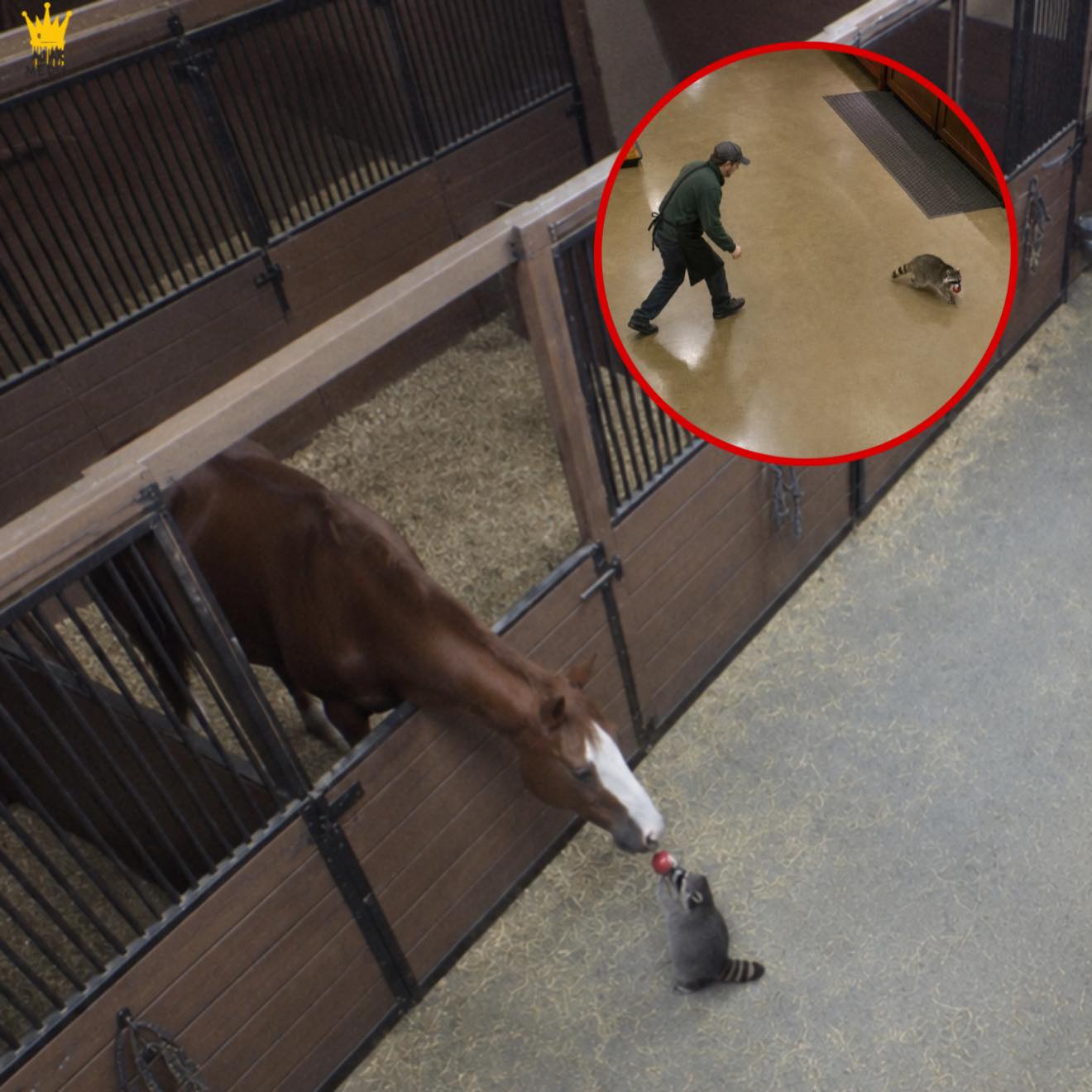
Every morning, exactly one apple disappeared from the same place. The reason was waiting in a barn a mile away.
At first, nobody at the small grocery store cared.
One apple missing from an outdoor crate was not exactly a crisis.
The display sat near the loading area, where workers moved boxes in and out before opening. Fruit rolled. Birds pecked at damaged pieces. Sometimes an apple disappeared beneath a pallet.
Then it happened again.
And again.
Always one apple.
Never two.
Never anything else.
On the fifth morning, an employee checked the security camera.
A raccoon appeared just before dawn.
It climbed onto the crate, selected an apple, tucked it against its chest, and left.
Everyone laughed.
“At least he’s disciplined,” someone said.
The next morning, the raccoon returned.
One apple.
Gone.
A week passed.
The routine did not change.
Meanwhile, a mile away, a farmer named Elias was worried about an old horse called Blue.
Blue had been recovering from an illness and had lost interest in food.
Hay remained untouched.
Grain lasted longer than it should.
Some days, he ate almost nothing.
Elias tried carrots.
Molasses.
Soft feed.
Blue accepted a little, then turned away.
One morning, Elias noticed an apple core in the stall.
He assumed someone had visited.
He threw it away.
The next morning, there was another.
Then another.
Blue began eating better.
Not much.
But enough that Elias noticed.
He asked everyone on the property who was bringing apples.
No one admitted it.
So he checked the barn camera.
At 5:42 a.m., a raccoon entered through a gap near the feed room.
It was carrying an apple.
It walked directly to Blue’s stall.
The horse lowered his head.
The raccoon stood on its hind legs and pushed the apple beneath the rail.
Blue ate it.
The raccoon sat nearby until he finished.
Then it left.
Elias watched the clip three times.
The next morning, he waited inside the tack room with the lights off.
Right on schedule, the raccoon appeared.
Apple in both paws.
It paused when it smelled Elias.
Then Blue shifted in the stall.
The raccoon looked toward the horse.
That seemed to settle the question.
It kept going.
Elias stayed still.
The apple slid beneath the rail.
Blue took it carefully.
The raccoon remained beside the stall door.
There was no touching.
No dramatic display of affection.
Just a familiar routine.
Two animals who clearly expected each other.
Elias began wondering where the apples came from.
There were no apple trees nearby.
The fruit looked clean and fresh.
Then, a few days later, he stopped at the grocery store.
An employee was complaining about “the most polite thief in Tennessee.”
Elias listened.
One raccoon.
One apple.
Every morning.
He pulled out his phone.
“Does your thief look like this?”
The employee watched the barn clip.
Then stared at Elias.
“You’re kidding.”
They compared timestamps.
The raccoon left the store shortly after five.
It arrived at Blue’s barn roughly thirty minutes later.
The route made sense.
The story did not.
Why would a raccoon repeatedly transport food instead of eating it?
Nobody could know exactly what motivated the animal.
Perhaps Blue had once dropped feed that the raccoon discovered.
Perhaps the barn had become a safe place.
Perhaps the apple-sharing behavior started accidentally and turned into routine.
What mattered to Elias was simpler.
Blue responded to it.
So instead of stopping the raccoon, the store began leaving a bruised apple near the back each morning.
No pesticides.
No packaging.
Nothing the animal would need to steal from a public display.
The raccoon adjusted instantly.
It took the apple.
Carried it to Blue.
Stayed until the horse finished.
Then disappeared.
Over the next few weeks, Blue improved.
He started eating hay again.
He gained weight.
He spent more time standing near the stall door at dawn.
Some mornings, the raccoon arrived before the horse was fully awake.
Other mornings, Blue was already waiting.
Then one day, the raccoon did not come.
Blue stood at the door longer than usual.
No raccoon.
The next day was the same.
On the third morning, it returned.
No apple.
It entered the barn slowly and sat near the stall.
One front paw was injured.
Elias placed food and water nearby but did not approach.
The raccoon rested there most of the morning.
Blue stayed beside it.
That afternoon, Elias left an apple inside the barn.
Blue did not eat it.
The raccoon did.
For the next week, the roles quietly reversed.
Elias left food near the stall.
Blue stood watch.
The raccoon recovered.
When it finally began traveling again, the apple routine returned.
By then, Blue no longer needed encouragement to eat.
Still, every dawn, the horse waited.
The raccoon came.
One apple.
Always one.
Months later, the visits became less frequent.
Wild animals move.
Seasons change.
Routines end.
But Elias kept the camera clips.
Not as proof that animals think exactly the way people do.
They do not.
He kept them because sometimes a pattern can become meaningful even when nobody can fully explain it.
A sick horse began eating again.
A raccoon kept showing up.
And every morning, between a grocery store and an old barn, one apple traveled farther than anyone expected.
 StoryTime
Wonderful, heart warming stories. I love these. Thank you.