

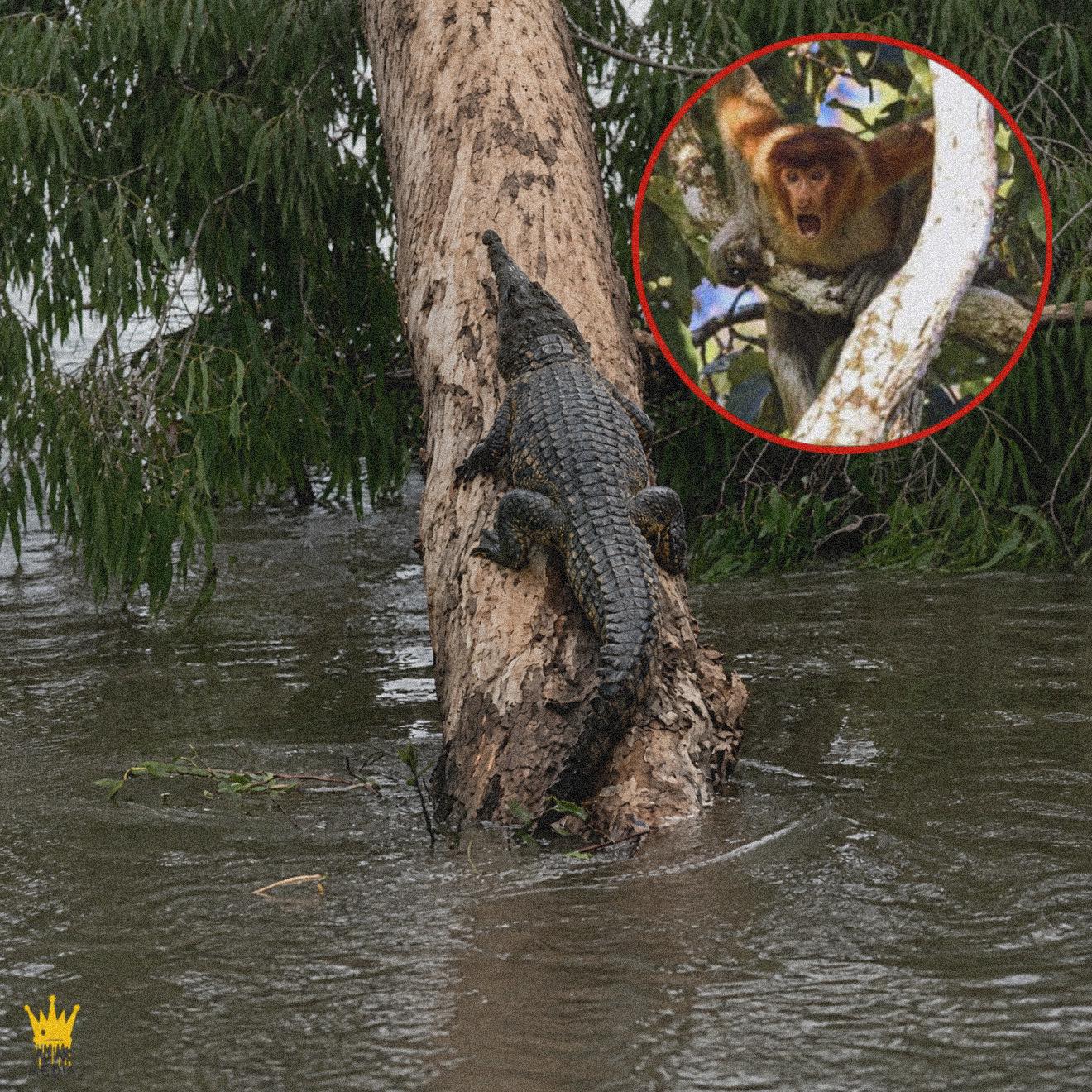
For years, the monkeys escaped danger by climbing higher. Then one morning, the threat followed them up.
The river had always been the dangerous part.
Everyone in the forest seemed to know it.
The macaques came down to drink quickly and nervously, never staying near the muddy bank longer than necessary. The young ones played in the branches above while adults watched the water. If a crocodile surfaced, the troop did what generations before them had done.
They climbed.
Height was safety.
The river belonged to the crocodiles. The canopy belonged to the monkeys.
At least, that was how the arrangement had always seemed.
A small wildlife team had been following the troop for several weeks, documenting how the animals moved between patches of forest along a narrow river corridor. Most mornings were predictable. The monkeys fed on fruit, argued loudly, groomed one another, and disappeared into the canopy whenever boats passed.
One researcher, Lena, had begun recognizing individuals.
There was an older female with a torn ear who always stayed near the juveniles. A large male with a pale patch across his shoulder usually moved first when the troop changed trees. And there was one fearless youngster who seemed determined to test every branch before the others trusted it.
On the morning everything changed, the troop had gathered above a bend in the river where a fallen tree leaned out over the water.
The trunk formed a natural bridge.
It was thick near the bank and narrowed as it stretched over the current. The monkeys loved it. They used it to move between two clusters of trees without touching the ground.
Lena’s team had watched them cross it dozens of times.
That morning, a crocodile surfaced beneath it.
No one was alarmed at first.
The monkeys noticed the animal immediately and moved higher into the branches. The crocodile drifted beneath the tree, almost completely still, with only its eyes and ridged back visible above the water.
“They’ve seen him,” Lena whispered.
Her colleague adjusted the camera.
For several minutes, nothing happened.
Then the crocodile turned toward the bank.
It pushed itself onto the mud.
Still normal.
Crocodiles rested on banks all the time.
It crawled toward the fallen tree.
Still possible.
Then it placed its front claws against the trunk.
Lena lowered her binoculars.
“What is it doing?”
The crocodile pulled itself forward.
Its belly scraped across the bark.
Slowly, awkwardly, it began moving up the leaning trunk.
The researchers stopped talking.
Above them, the monkeys had gone silent too.
The crocodile was not climbing the way a cat or monkey would climb. It could not wrap itself around the trunk or balance easily. Instead, it used the angle of the fallen tree, its claws, and the rough bark to drag its body upward a few inches at a time.
But upward was enough.
The monkeys understood the problem before the people did.
The pale-shouldered male barked sharply.
The troop exploded into motion.
Adults pulled juveniles closer. Several animals leapt from the fallen tree into the surrounding branches. Leaves shook everywhere at once.
The fearless youngster hesitated.
He was farther out on the trunk than the others, directly above the river.
To reach the nearest safe branch, he would have to jump sideways across a gap.
Below him, the crocodile kept climbing.
It was not fast.
That somehow made the scene worse.
There was no sudden attack, no splash, no dramatic charge.
Just steady progress.
Claw.
Pull.
Pause.
Claw.
Pull.
The youngster moved higher along the trunk instead of jumping.
Wrong direction.
“Come on,” one of the researchers whispered, forgetting for a moment that the animal could not hear him.
The old female with the torn ear moved back toward the youngster.
She stretched across a branch, calling repeatedly.
The youngster looked at her.
Then at the gap.
Then down.
The crocodile was closer now.
Not close enough to strike, but close enough that the safe distance was disappearing.
The youngster jumped.
For a fraction of a second, there was nothing beneath him.
Then both hands caught the branch.
His body swung hard beneath it.
The old female grabbed at his arm while he kicked for leverage.
He pulled himself up.
At almost the same moment, the crocodile reached the narrowest part of the trunk.
The angle had become steeper.
Its claws slipped.
The entire body shifted sideways.
With a heavy scrape, the crocodile slid backward several feet, lost its grip, and dropped into the river.
The splash sent the remaining monkeys racing deeper into the canopy.
For several seconds, the researchers could only hear branches shaking.
Then the forest settled.
“Did we actually get that?” Lena asked.
The camera operator checked the screen.
He nodded.
They watched the footage twice that afternoon.
The second viewing was stranger than the first because they could see the entire sequence without the panic of not knowing how it would end.
The crocodile had not scaled a vertical tree.
It had used a low, leaning trunk like a ramp.
That distinction mattered.
But so did the monkeys’ reaction.
They clearly had not expected the animal to follow them onto the wood.
The next morning, the troop returned to the area.
But not to the fallen tree.
They stopped in the canopy several meters away.
The pale-shouldered male watched the trunk for a long time before moving on.
Over the following days, the researchers noticed something else.
The troop changed its route.
Instead of using the fallen tree to cross the river bend, they took a longer path through denser branches farther inland.
It cost them time.
But it kept them away from the water.
Then, three mornings later, the crocodile returned.
It surfaced beneath the same tree.
It waited.
No monkeys came.
The animal rested near the bank for almost an hour before disappearing downstream.
Lena stood looking at the empty trunk.
“Maybe they learned faster than he did,” she said.
The forest was full of boundaries that seemed obvious until something crossed them.
Water and land.
Predator and prey.
Danger below. Safety above.
But survival was never really about fixed rules.
It was about noticing when the rules changed.
The monkeys had spent their lives trusting height.
One strange morning was enough to teach them that even a safe place could stop being safe.
And after that, they never used the fallen tree the same way again.
 StoryTime