

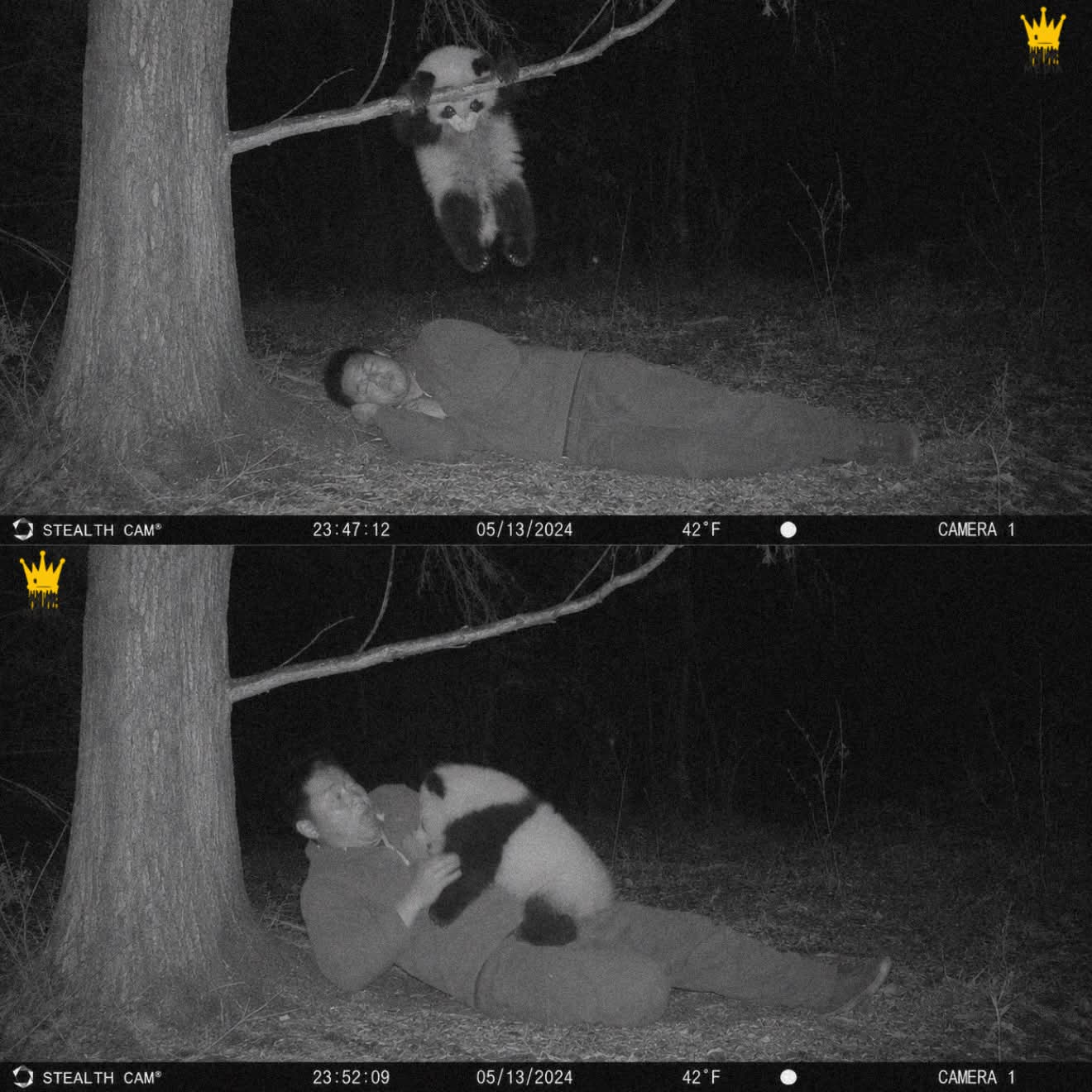
The thing landed on Bo’s stomach with a soft, heavy thump, and he woke up swinging.
His first thought was that a sack of grain had fallen out of the sky. His second thought, sharper and far more embarrassing, was that someone had jumped him while he slept.
“Hey!” he shouted, flinging both arms into the dark. “Get off! Get—what are you doing?”
Something squeaked.
Bo froze.
The night around him was thick and damp, smelling of wet leaves, stone dust, and the iron handle of the water buckets he had dropped beside the path. A few minutes earlier, he had only meant to sit under the old tree and rest his back. His shoulders were sore from carrying water up the slope, his knees ached, and the air had been so still beneath the branches that his eyes had closed before he could argue with them.
Now there was a round black-and-white face inches from his.
A panda cub stared at him.
Not a dream panda. Not a painted festival toy. A real cub, small enough to still look unfinished, with damp fur sticking out at odd angles and eyes wide with the same offended panic Bo felt in his own chest.
For a moment, neither of them moved.
Then Bo whispered, “Where did you come from?”
The cub blinked.
Bo slowly lifted his head. There was a dull ache across his belly where the little animal had landed. Above him, branches tangled against the moonless sky. One broken twig trembled overhead. Another leaf spun lazily down and settled on his shirt, as if the tree itself had decided to provide evidence.
“You fell?” Bo said.
The cub made a grumbling sound and tried to climb off him. One paw pressed into Bo’s ribs. Another slid on the cloth of his shirt. The cub’s claws were tiny but sharp enough to make him suck in a breath.
“All right, all right,” he said, trying not to laugh and not to cry out. “Careful, little dumpling.”
The panda cub paused at the word dumpling, looked directly at him, and sneezed.
Bo, who had spent the first half of his life insisting nothing surprised him anymore, began to laugh. It came out ragged, the kind of laugh that followed fear too closely. He covered his mouth with one hand and lay there under the tree, staring at the animal perched on his stomach like an upset landlord.
The cub sniffed his sleeve.
“No,” Bo said. “I am not bamboo.”
The cub sniffed harder.
Bo turned his face away, half expecting someone from the village path to appear and accuse him of kidnapping wildlife with his abdomen. But the path was empty. The only sound was the thin rush of water somewhere down the hill and the restless scratching of insects in the grass.
A small red blink caught his eye.
The trail camera.
It was strapped to a narrow trunk a few steps away, angled toward the lower branches where animals sometimes crossed after dark. Bo had noticed it before and had always pretended he didn’t. People liked to set up cameras now. They liked to catch deer, birds, wild pigs, anything with glowing eyes. He had never imagined himself becoming part of the entertainment.
“Oh no,” he muttered.
The cub climbed down at last, landing beside him with an unsteady plop. It shook itself, then sat back and gazed at Bo’s face as if trying to decide whether he had been placed there for panda purposes.
Bo pushed himself upright. His hat had fallen somewhere behind his shoulder. His shirt was wrinkled, his breath still short. He glanced toward the buckets lying on their sides, water spilled into dark patches on the dirt.
“That was for my house,” he told the cub.
The cub looked at the water, then at him.
“Yes, mine,” Bo said. “You and I are both having a difficult evening.”
The cub took two slow steps toward his knee.
Bo held very still.
He knew enough to be careful. Every child in the hills learned that soft-looking animals were still wild animals, and that babies usually meant a mother somewhere close enough to be offended. But knowing something in daylight and remembering it with a warm, confused panda cub inches from your hand were two different things.
The cub’s fur looked softer than cotton padding. A leaf clung to one round ear. It had landed badly, but it did not seem hurt. Only startled. Its little nose worked constantly, reading the world in smells Bo could not imagine.
“Did you lose your mother?” Bo asked quietly.
The cub answered by stepping on his foot.
Bo winced. “Not helpful.”
He looked around again, this time more carefully.
The trees beyond the path formed a black wall. In the daylight, he knew every bend of this track, every exposed root and leaning stone. At night, it belonged to other things. The bamboo farther down the slope whispered though there was almost no wind, its leaves brushing together like old women sharing secrets.
The cub made a soft whining sound.
Bo’s heart pulled tight.
“Oh,” he said. “You are lost.”
He reached for one bucket, then stopped. What was he going to do, carry a panda cub home in a water bucket like a turnip? He pictured his aunt opening the door and seeing him arrive with a wild animal tucked under one arm.
She would hit him with a broom first and ask questions after.
The cub wandered toward the spilled water and sniffed it. Then it looked back at Bo, as if expecting him to fix the entire situation.
“I can’t keep you,” he said, though his voice had already softened in the dangerous way that meant he was considering foolishness. “You hear me? I have one room, two blankets, and a neighbor who complains when my shoes are too loud. You cannot come home with me.”
The cub sat down.
Bo sighed.
That was when the branches moved.
Not above him this time. Across the path.
Slowly, silently, a much larger shape separated itself from the dark. Black shoulders. Pale face. Heavy paws placed with astonishing care on the wet ground.
Bo stopped breathing.
The mother panda stood between two tree trunks, watching him.
She did not growl. She did not charge. She simply looked, and that was enough to make Bo’s hands rise, palms open, as if she were a village elder who had caught him doing something stupid.
“I didn’t take him,” Bo said at once.
His own voice sounded ridiculous in the trees.
The mother’s ears twitched.
Bo shifted backward, inch by inch, making himself smaller. “He fell. From there.” He pointed upward, then immediately regretted pointing at all and lowered his hand. “He fell on me. I was sleeping. That is all. Very poor aim, your child.”
The cub turned at the sound of leaves under its mother’s paws. Its whole body changed. The uncertain wobble went out of it. It made a chirping sound and started toward her, then stopped after three steps to look back at Bo.
“Go on,” Bo whispered.
The cub hesitated.
For reasons Bo would later fail to explain, that small hesitation went through him harder than the fall had. The little animal had been in his life for only a few minutes, most of that time on his stomach or foot, and still he felt a strange tenderness toward it, like one feels toward a child who has mistaken your house for theirs during a storm.
The mother moved closer.
Bo leaned back farther until his shoulder touched the tree trunk. His spilled buckets gleamed beside him. His hat lay upside down in the dirt. He must have looked like a man defeated by laundry.
The cub reached its mother and pressed itself against one thick foreleg.
The mother lowered her head. She sniffed the cub’s back, its ear, the place where it had tumbled from the branch and into Bo’s sleep. Satisfied, or at least no longer furious, she nudged the cub with her nose.
The cub stumbled sideways.
Bo covered his mouth again, because laughing in front of a mother that large seemed disrespectful.
The cub recovered and followed her toward the trees. It walked three steps, then sat suddenly, as if the night had become too much work. The mother stopped. Without any hurry, she returned, nudged it again, and waited.
This time the cub got up.
Together they moved into the dark, the little one bumping once against a root, the mother slowing without looking back. Leaves closed behind them. The black-and-white shapes blurred, then disappeared completely.
Bo sat under the tree for a long time after they were gone.
His heart was still beating too fast. His stomach hurt. His dignity, he suspected, had been left somewhere near the first wild swing of his arms.
At last he stood, brushed leaves from his shirt, and gathered his buckets. Most of the water was gone. He would have to walk down again.
Before he left, he looked at the trail camera blinking patiently on its tree.
“Don’t you dare,” he told it.
The red light blinked once.
By morning, everyone knew.
His neighbor called out before Bo had even finished tying his shoes. At the tea stall, three old men clutched their cups and demonstrated his flailing arms with cruel accuracy. Someone had already watched the footage enough times to imitate the cub’s fall in slow motion. Bo tried to act annoyed, but he could not stop smiling into his bowl.
When a child asked whether the panda had attacked him, Bo shook his head.
“No,” he said. “It landed badly.”
“And you were scared?”
Bo looked toward the hills, where the trees were bright now with morning sun. Somewhere beyond them, a cub with terrible balance was probably climbing something it should not.
“Yes,” Bo said. “But only because I woke up before I knew who my visitor was.”
That evening, when he carried water home again, he did not sleep under the tree.
He did pause beneath it, though, and leave one careful glance among the branches before continuing up the path.
 StoryTime